Chapter 14
Working the Ground
Ground control moves departures from the stand to the runway and arrivals back to the ramp, using named taxi routes and strict hold-short readbacks.
The movement area and who owns it
Chapters 10 through 13 kept your attention on the active runway and the airspace immediately around it: lining departures up, clearing them for takeoff, landing arrivals, and protecting the pavement when a gap closed. Every one of those flights also has a trip on the ground between the stand and the runway. Moving aircraft across the airport surface without conflicts or wrong turns is the job of Ground controlThe tower position that owns the taxiways. It delivers departures to the holding point and takes arrivals back once they are clear of the runway.Open in the glossary.
An airport surface divides into the movement area, where the tower issues instructions, and nonmovement areas, which the pilot, operator, or airport management handle (often marked on the pavement). Ramps, gate alleys, parking stands, and hangar aprons are nonmovement areas; movement there is the responsibility of the pilot, the airline's ramp control, or the airport operator. Once an aircraft moves from the ramp onto a taxiway, it enters the movement area, which comprises every taxiway and runway on the field. Every move on the movement area requires a specific instruction from the control tower, except where permitted in a letter of agreement.
Issue by radio or directional light signals specific instructions which approve or disapprove the movement of aircraft, vehicles, equipment, or personnel on the movement area except where permitted in an LOA.
Do not use the word "cleared" in conjunction with authorization for aircraft to taxi or equipment/vehicle/personnel operations. Use the prefix "taxi," "proceed," or "hold," as appropriate, for aircraft instructions and "proceed" or "hold" for equipment/vehicles/personnel.
Notice the vocabulary rule in the second part of that order: on the ground, you never say "cleared to taxi." Because the word "cleared" is reserved for takeoff, landing, approach, and en route clearances, keeping it out of taxi instructions ensures that a crew in a busy cockpit cannot mistake a taxi call for permission to take off.
Inside the tower cab, ownership of the movement area splits along the yellow hold-short bars painted across every taxiway before it meets a runway. Ground control owns the taxiways and any inactive runways assigned to it by facility procedure. Local controlThe tower position that owns the active runway and the sky immediately around it; Tower on the radio. Every use of the runway happens on its say-so.Open in the glossary is the tower position you worked in chapters 10 through 13, and it owns the active runways. A ground controller can move an aircraft anywhere on the taxiway network, but neither a pilot nor a ground controller may put an aircraft across a hold-short bar onto an active runway without the local controller's authorisation.
Building a taxi clearance
When a departure calls ready to taxi from the stand, the crew needs to know which runway the flight is assigned, which taxiways lead there, and where to stop along the way. A standard departure taxi clearance gives those three items in that fixed order.
Issue the route for the aircraft/vehicle to follow on the movement area in concise and easy to understand terms. The taxi clearance/route must include the specific route to follow. When a taxi clearance to a runway is issued to an aircraft, confirm the aircraft has the correct runway assignment.
When authorizing an aircraft to taxi to an assigned takeoff runway, state the departure runway followed by the specific taxi route. Issue hold short instructions, in accordance with subparagraph a above, when an aircraft will be required to hold short of a runway or other points along the taxi route.
Flight crews compute takeoff speeds and flap settings for a specific runway length and wind component, and they brief the departure path from that threshold, so the clearance opens with the runway. When you open the clearance with "runway two five right" and the pilot reads those words back first, both of you confirm the runway assignment before the aircraft moves a foot. After the runway comes "taxi via" and the phonetic name of every taxiway on the route in sequence, followed by a hold-short or crossing instruction for any runway that intersects the path.
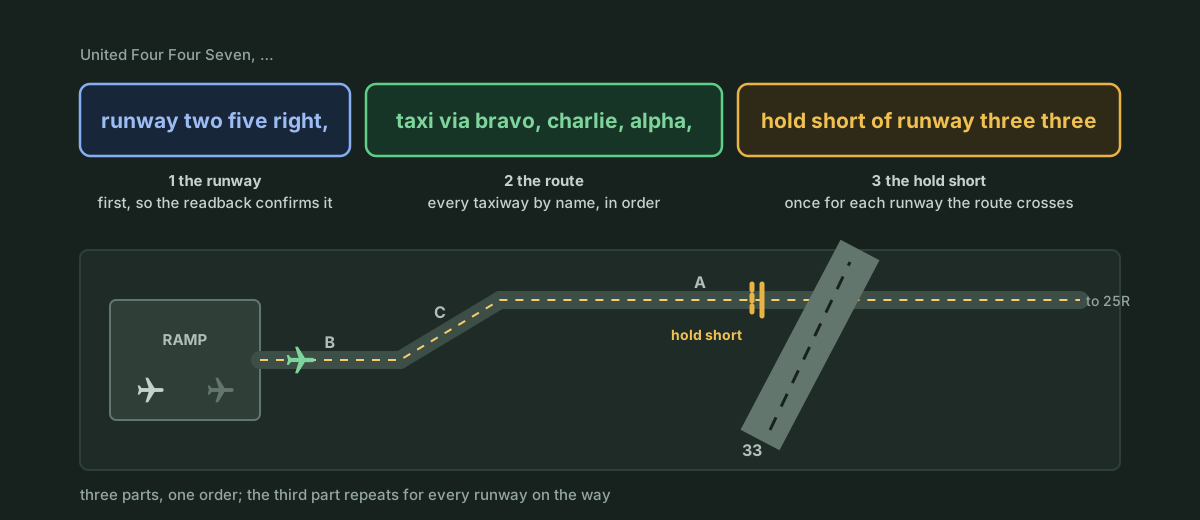
At Bayview, a departure parked at the ramp takes bravo, charlie, and alpha to the two five right Holding pointThe marked position at the runway entrance where a departure waits for its clearance. Crossing the marking without one is a runway incursion.Open in the glossary and crosses no runway. Here is how that call sounds on Bayview Ground.
Bayview Ground, United Four Four Seven, at the ramp, ready to taxi.
United Four Four Seven, Bayview Ground, runway two five right, taxi via bravo, charlie, alpha.
Runway two five right, taxi via bravo, charlie, alpha, United Four Four Seven.
A taxi clearance authorises the aircraft to cross every taxiway that intersects its assigned route unless you instruct the pilot to Hold shortStop before the runway's holding position marking and do not enter. Hold short instructions must be read back.Open in the glossary of a specific taxiway. A taxi clearance never implies permission to cross a runway, even when the assigned taxiway continues straight across the runway pavement on the other side.
For an arrival that has landed and exited the active runway, the structure is the same except that the destination is a parking area on the airport surface instead of a takeoff threshold. Once the aircraft is across the hold-short line and on the ground frequency, you state the destination such as "taxi to the ramp", follow it with "via" and the ordered list of taxiways, and add a hold-short or crossing instruction for every runway between the turn-off and the ramp. At Bayview, "taxi to the ramp via alpha, charlie, bravo, hold short of runway three three."
Runway crossings and the hold-short readback
Chapter 13 introduced Runway incursionAnything on protected runway surface that should not be there: an aircraft past its hold line, a vehicle without approval. The accident category towers exist to prevent.Open in the glossary from the local controller's seat; many involve an aircraft or vehicle on a taxiway approaching a runway. The primary defence against an unauthorised runway entry is strict discipline around hold-short instructions and their ReadbackThe pilot repeating a clearance or instruction back so the controller can verify it was received correctly.Open in the glossary. Every runway that a taxi route intersects gets its own explicit instruction, either to hold short of that runway or to cross it at a named taxiway. Unless the air traffic manager has approval for airports where the taxi distance between runway centrelines is 1,300 feet or less, you issue one runway crossing at a time.
Whenever you instruct an aircraft to hold short of a runway, you must hear the pilot read back both the hold-short instruction and the runway designator. An acknowledgement consisting only of "RogerRoger.I received your whole transmission. It does not mean yes, and it is not a readback.Open in the glossary", "WilcoWilco.I received your instruction and will comply. Stronger than roger; still not a readback of the numbers.Open in the glossary", or the callsign does not satisfy the rule, and neither does reading back the taxiway letters while dropping the hold short at the end. When any part of the hold-short readback is missing or wrong, you challenge it immediately.
Request a read back of runway hold short instructions when it is not received from the pilot/vehicle operator.
PhraseologyREAD BACK HOLD INSTRUCTIONS.
American Two One Five, Bayview Ground, taxi to the ramp via alpha, charlie, bravo, hold short of runway three three.
Taxi to the ramp via alpha, charlie, bravo, American Two One Five.
American Two One Five, read back hold instructions.
Hold short of runway three three, American Two One Five.
When the aircraft reaches the hold-short bar at runway three three and traffic allows it to cross, the clearance names both the runway and the taxiway where the crossing takes place: "cross runway three three at alpha." Including the taxiway designator prevents a pilot near a complex intersection from crossing on an adjacent diagonal turn-off.
Before you speak a crossing clearance, you scan the runway out the cab window and on the surface display, checking both thresholds, the full length of the pavement, and the final approach course. During departure operations on that runway, the crossing aircraft must remain behind the hold-short markings until you visually observe the departing aircraft in a turn or past the crossing intersection. During arrival operations, the crossing aircraft must either be completely across the far hold-short line before the arrival crosses the landing threshold, or wait until the arrival has rolled past the crossing taxiway. You never issue a conditional crossing clearance that asks a pilot to judge the gap behind a moving aircraft, such as "cross runway three three behind the landing jet." You hold the aircraft short until the runway is clear at that intersection, and then issue the direct crossing instruction.
Bayview Tower, United Four Four Seven, holding short of runway three three at alpha.
United Four Four Seven, cross runway three three at alpha.
Cross runway three three at alpha, United Four Four Seven.
Stopping traffic and progressive taxi
Even a well-planned taxi route occasionally needs to be interrupted after the aircraft is moving. Another flight may push back late, an arrival may take a different turn-off than expected, or two aircraft converging on an intersection may need their order changed. To stop a taxiing aircraft where it is on a taxiway, issue "hold position." When the path is clear again, "continue taxiing" releases the aircraft to resume the route it was already assigned.
Delta Eight Eight, hold position.
Holding position, Delta Eight Eight.
Delta Eight Eight, continue taxiing.
Continue taxiing, Delta Eight Eight.
If an aircraft is about to cross a hold-short line without authorisation, or if an immediate hazard develops anywhere on the field including on a runway, you can transmit "stop stop stop" to halt the aircraft at once.
There are also situations where issuing a full multi-taxiway route up front is the wrong tool. A visiting pilot may be unfamiliar with the airport layout and ask for help, construction may have closed standard connectors, low visibility may hide distant taxiway signs, or you may want to release a busy route one junction at a time. That method is called progressive taxi. Instead of reading the entire route from the ramp to the runway in one transmission, you give the pilot one segment at a time with a turn direction and a stopping point, and issue the next step as the aircraft nears the intersection.
Bayview Ground, Delta Eight Eight, unfamiliar with the field, request progressive taxi to runway two five right.
Delta Eight Eight, Bayview Ground, runway two five right, taxi via bravo, hold short of charlie.
Taxi via bravo, hold short of charlie, Delta Eight Eight.
Delta Eight Eight, turn left on charlie, hold short of alpha.
Turn left on charlie, hold short of alpha, Delta Eight Eight.
Working ground and tower on one frequency
At busy airports during daytime pushes, ground control and local control operate as separate seats on separate frequencies. Ground moves aircraft from the ramp to the active runway's holding point, and takes arrivals back to the stand once local control turns them off the runway and switches them over. During quiet hours, or at smaller towers throughout the day, a facility often combines ground and local control onto a single frequency worked by one controller.
When you work combined ground and tower, you own the entire movement area: the active runways, any crossing runways, and every taxiway between the stands and the thresholds. Departures call you on the tower frequency while parked at the stand to ask for taxi, and arrivals stay on your frequency after rolling clear of the runway to ask for their route to the ramp.
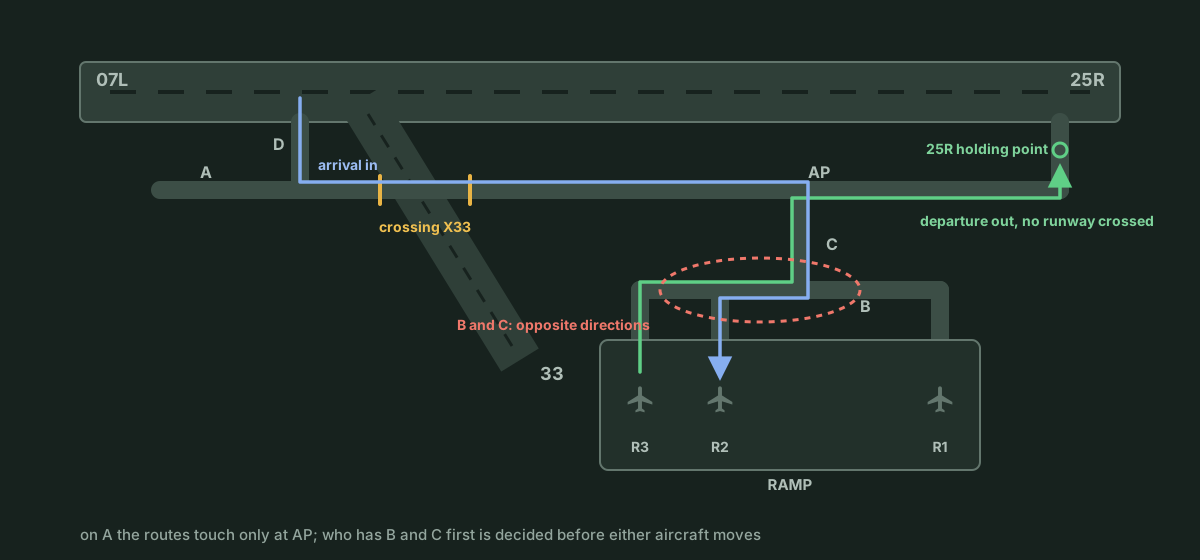
The hardest part of working combined ground and tower is managing shared single-lane taxiways while running the active runway at the same time. Look at the surface map of Bayview in the figure above. Departures to runway two five right leave the ramp on bravo, turn onto charlie, and follow alpha to the holding point. Arrivals landing on runway two five right roll out toward the far end, leave on one of the turn-offs delta to hotel, join alpha and taxi back along it, across runway three three, then in via charlie and bravo to the ramp.
Both streams use charlie and bravo in opposite directions, and two aircraft cannot pass each other on a single taxiway. If you release a departure from the ramp onto bravo and charlie while an arrival is taxiing in over the same taxiways, the two are nose to nose and one must give way. Hold the departure at the stand or on bravo until the arrival has passed charlie and bravo, then release it.
Bayview Tower, American Two One Five, clear of runway two five right, request taxi to the ramp.
American Two One Five, Bayview Tower, taxi to the ramp via alpha, charlie, bravo, hold short of runway three three.
Taxi to the ramp via alpha, charlie, bravo, hold short of runway three three, American Two One Five.
Bayview Tower, United Four Four Seven, at the stand, ready to taxi.
United Four Four Seven, Bayview Tower, runway two five right, taxi via bravo, hold short of charlie.
Runway two five right, taxi via bravo, hold short of charlie, United Four Four Seven.
In the Sim
Before starting a tower shift at Bayview in ATC Simulator, you choose whether ground control is Separate or Combined. In Separate mode, an automated ground controller handles taxi clearances between the stands and the runways while you work local control. Even with ground separate, you still own every runway on the field: whenever a taxiing aircraft reaches the hold-short bar of a runway (at Bayview with runway two five right in use, an arrival taxiing in along alpha at runway three three), the pilot calls you on the tower frequency requesting permission to cross, and repeats that request every thirty seconds until you answer. In Combined mode, you work both positions on a single frequency; departures call you at the stand for taxi to runway two five right, and arrivals ask you for taxi in to the ramp after leaving the runway.
You issue taxi clearances by speaking the taxiway names in sequence, or by assembling the route in the touch taxiway picker when playing without a microphone. The simulation checks every route against the airport geometry. If you name a string of taxiways that do not connect into a continuous path, the pilot refuses the clearance instead of guessing how to get from one taxiway to the next. Progressive taxi is also modelled: if you give a single step such as "turn left on charlie", the aircraft taxis to the end of that segment, stops, and calls back for further taxi instructions. While an aircraft is moving, "hold position" stops it on the taxiway and "continue taxiing" releases it; "stop stop stop" halts any aircraft on the field immediately, including one rolling on a runway.
Pilots in the simulation read back hold-short instructions with the runway designator, and using standard phraseology earns points on your shift score sheet, while a runway incursion costs a strike. When you fly from the Pilot in Command seat, you work the same surface rules from the cockpit: you taxi along your cleared route by choosing left, straight, or right at each intersection, and leaving the cleared route is recorded as a pilot deviation and prompts the tower's possible pilot deviation notice. Where ATC Simulator differs from a working tower cab is off-frequency coordination. In an airport control tower, controllers coordinate pushbacks, ramp congestion, and runway crossings with ramp control and adjacent positions over telephone and interphone lines; the single-player simulation omits those landlines and keeps all ground and crossing work on your radio frequency.