Chapter 15
Weather and the Runway Change
How tower controllers maintain the ATIS broadcast, calculate headwind and crosswind components, and turn the airport around when a front shifts the wind.
The weather recording and the phonetic letter
In chapters 10 through 14, the active runway was already set before you keyed the microphone. Chapter 8 showed from the approach scope that shifting winds can force an airport onto a different runway, and in the tower cab that decision belongs to you. Everything starts with the weather observation and the broadcast that carries it to the cockpits.
The Automatic Terminal Information Service, or ATIS, is a continuous recorded broadcast of current weather and operating information for the airport. A single recording gives the airport name, a phonetic letter code, the observation time, the surface wind in degrees magnetic, prevailing visibility, sky condition and ceiling, temperature, dew point, altimeter setting, the instrument approach in use, the active landing and departure runways, and any pertinent NOTAMs, braking action reports, or operational remarks. Because every arriving and departing crew listens to that loop before calling a controller, you do not have to read a long block of weather numbers to each aircraft on initial contact. When a pilot checks in with the current phonetic letter, you know the crew already has the weather and the active runway.
Maintain an ATIS message that reflects the most current arrival and departure information.
When a pilot does not state the appropriate ATIS code on initial contact, ask the pilot to confirm receipt of the current ATIS information.
Advise aircraft of changes to the ATIS code by broadcasting the change on all appropriate frequencies. The broadcast must include changes to pertinent operational information, when known, that necessitated the ATIS change.
San Diego Tower, United Four Four Seven, holding short of runway two seven, ready for departure.
United Four Four Seven, San Diego Tower, verify you have information Mike.
Information Mike, we have it now, United Four Four Seven.
If an aircraft has a receiver failure or calls from outside broadcast range and cannot copy the ATIS, you issue the current wind, visibility, ceiling, altimeter, approach and departure runways, and pertinent airport conditions directly on the control frequency. You also issue the latest ceiling, visibility, altimeter, or surface wind on the frequency whenever conditions are changing too quickly for a recording to keep pace.
The tower records a new ATIS message and advances to the next phonetic letter whenever a new official weather observation arrives, whether the numbers changed or stayed the same. You also cut a new recording immediately when pilots report braking action worse than the broadcast states, or when any pertinent operating data change, such as a runway change or a switch to a different instrument approach. Each time the letter advances, you make a general broadcast on your frequency announcing the new letter and the operational change behind it. Pilots already on the frequency do not read back a general broadcast, which keeps twenty crews from keying up at once to acknowledge the same announcement.
Visibility changes bring an additional duty in the cab. When prevailing visibility at the surface or at tower level drops below four miles, a certified observer in the tower takes visibility readings and the airport operates using the lower of the tower or surface observation. A fog bank or a low ceiling takes the visual approach away and sends the field to its instrument approaches.
Headwind, crosswind, and tailwind
Surface winds in the ATIS and in tower clearances are always reported in degrees magnetic, matching the aircraft's magnetic compass and the magnetic headings of the runways. Under three knots the wind is reported as calm and does not decide the runway.
Describe the wind as calm when the wind velocity is less than three knots.
At three knots and above, the wind report gives a magnetic direction from which the air is moving and a speed in knots. An aircraft rolling down a runway feels that wind along two axes at right angles: parallel to the runway centreline and perpendicular to it. The component along the runway is the wind speed multiplied by the cosine of the angle between the wind direction and the runway magnetic course. The component across the runway is the wind speed multiplied by the sine of that angle.
Consider San Diego International when the wind shifts offshore to 070 degrees at 8 knots. On runway 27, with a magnetic course of 275 degrees, that 070-degree wind comes from 25 degrees off the tail. Multiplying 8 knots by the cosine and sine of 25 degrees gives a seven-knot tailwind down runway 27 and a three-knot crosswind. Flipping the single pavement to runway 9 (magnetic course 095 degrees) puts the 070-degree wind 25 degrees off the nose, replacing the seven-knot tailwind with a seven-knot headwind.
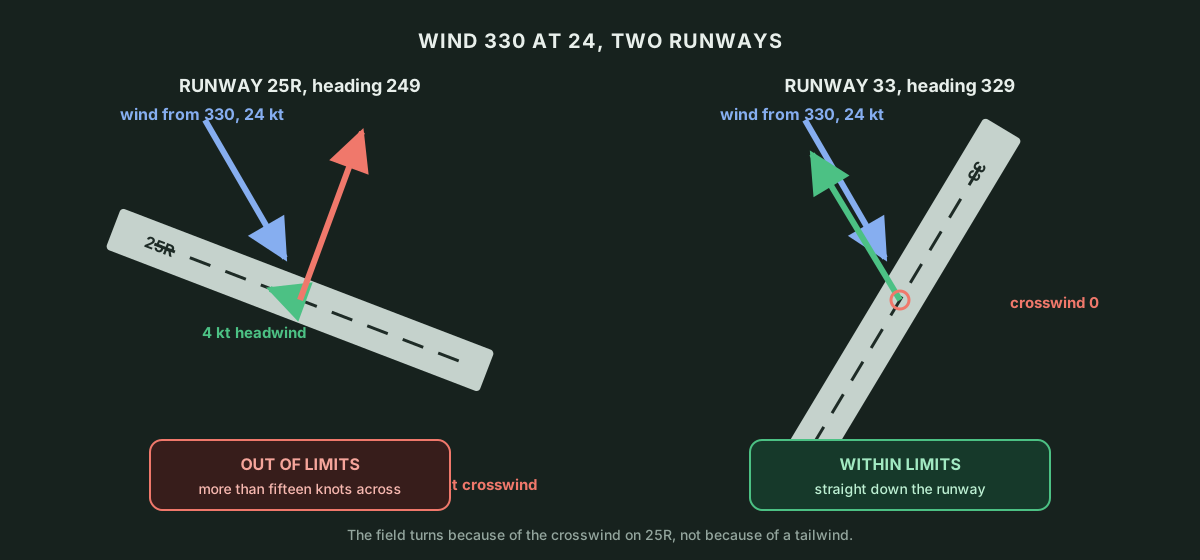
Those components govern how much pavement an aircraft uses. Aircraft lift off and touch down at a target airspeed through the airmass, while the landing gear rolls over the concrete at groundspeed. A 20-knot headwind lets an airliner flying a 140-knot final approach touch down at a groundspeed of 120 knots, shortening the landing roll and helping the crew make an earlier turnoff. A tailwind pushes from behind and adds directly to groundspeed. A 10-knot tailwind puts that same arrival onto the runway at 150 knots over the ground, lengthening the rollout and putting extra heat into the brakes. On departure, a tailwind requires the aircraft to accelerate to a higher groundspeed before the wings produce enough lift to rotate, using up hundreds of feet of additional runway.
When authorizing use of runways and a tailwind component exists, always state both wind direction and velocity.
Aircraft flight manuals and airline operations specifications set hard limits on tailwind and crosswind components. Most transport jets are restricted to a maximum tailwind of 10 knots, and many HeavyUnited Four Heavy, SoCal Approach.A wake-turbulence class carried in the callsign of aircraft able to take off at 300,000 pounds or more, because the wake they leave behind is a hazard to whoever follows.Open in the glossary operators set their company tailwind limit even lower. Crosswind limits depend on rudder authority, wing geometry, and runway surface condition; dry pavement allows higher crosswinds than wet or snow-covered pavement. The pilot in command is the final authority on whether a runway is acceptable for the aircraft. When you issue a takeoff or landing clearance on a runway whose tailwind or crosswind exceeds the aircraft's operating limit, the pilot is entitled to refuse the clearance and request a runway aligned with the wind.
Alaska Three One Eight, San Diego Tower, runway two seven, wind zero seven zero at one two, cleared for takeoff.
Unable runway two seven, tailwind, request runway zero niner, Alaska Three One Eight.
Choosing the active runway
Many towered airports operate under a facility runway use programme that designates a primary configuration for calm and light-wind periods. That default choice reflects terminal ramp geometry, taxiway layout, surrounding terrain, and noise abatement routes over nearby neighbourhoods. At San Diego International, with the terminals on the south side and the prevailing breeze off the Pacific, runway 27 is the primary runway for both arrivals and departures.
Switching runways reverses every arrival and departure flow, so an airport stays on its configuration through small wind shifts. If the tower changed runways on every light gust, approach control would spend the shift turning arrival streams back and forth and Ground controlThe tower position that owns the taxiways. It delivers departures to the holding point and takes arrivals back once they are clear of the runway.Open in the glossary would have departure queues meeting head-on along the parallel taxiways. To keep the operation stable, a field normally stays on its preferred runway until the wind favours the other direction by a clear margin.
When a weather front passes the field, the wind shift is large and sustained. Over several minutes, the direction swings through sixty or ninety degrees and the velocity climbs past twenty knots, driving the crosswind or tailwind on the primary runway above the airport's operating limits. Once the wind settles in its new quadrant, keeping the old runway is no longer practical, and the tower initiates a runway change.
Turning the field around
A runway change is a coordinated facility procedure that touches every active aircraft in the terminal area. In a facility with separate control positions, the tower coordinates by landline with approach control, ground control, clearance delivery, and airport operations before changing a single clearance. Approach control sets a cutoff aircraft in the arrival stream so every subsequent flight is vectored to the new final approach course, while ground control stops taxiing new departures toward the old threshold.
Traffic caught in the middle of the transition is handled aircraft by aircraft so two opposing flows never occupy the same piece of pavement. Arrivals already established on final and cleared for the old runway are normally allowed to continue and land on that runway, provided the wind stays within the pilot's limits. You restate the surface wind with the landing clearance so the crew knows the exact crosswind or tailwind on short final. Departures holding short or taxiing toward the old runway are held and re-taxied to the new departure threshold. An aircraft still on the taxiway has no reason to launch into a strong crosswind or tailwind when it can taxi to the favoured runway. A new ATIS recording is placed on the air showing the new landing and departure runways and carrying the remark that a runway change is in progress, followed immediately by a broadcast on the control frequencies.
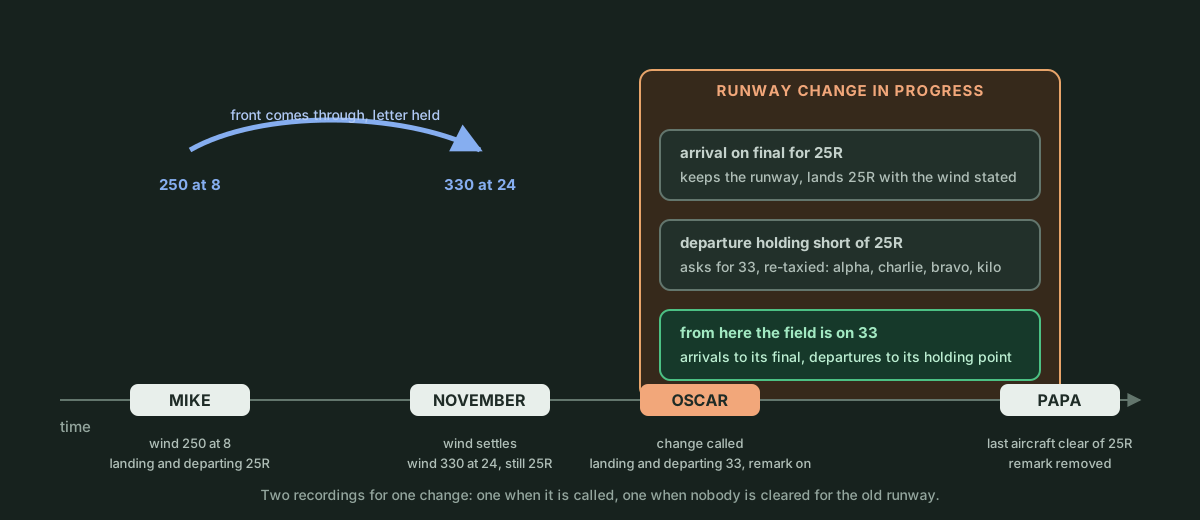
Broadcasting "runway change in progress" tells every crew on the frequency that the last arrivals are still landing in the old direction while departures reposition to the opposite end. At San Diego International, a departure holding at the east end on Bravo One stays on the south side of the runway during a change from 27 to 9, taxiing about three kilometres west along parallel taxiway Bravo to the runway 9 threshold while the last arrival rolls out on 27 and exits left toward the terminal ramp.
Attention all aircraft, information Oscar current, landing and departing runway zero niner, runway change in progress.
San Diego Tower, Delta One Two Zero, holding short of runway two seven, we will need runway zero niner.
Delta One Two Zero, San Diego Tower, runway zero niner, taxi.
Runway zero niner, taxi, Delta One Two Zero.
American Two One Five, San Diego Tower, runway two seven, wind zero seven zero at eight, cleared to land.
Runway two seven, cleared to land, American Two One Five.
Once American Two One Five rolls out and exits runway 27, and no traffic remains committed to the west-flow direction, the tower cuts one more ATIS recording with the transition remark removed, and the airport settles into normal operations on runway 9.
In the Sim
In ATC Simulator, San Diego International has a single runway, 9/27, with magnetic courses of 095 and 275 degrees. The terminal gates and both departure Holding pointThe marked position at the runway entrance where a departure waits for its clearance. Crossing the marking without one is a runway incursion.Open in the glossary lie on the south side along parallel taxiway Bravo, so terminal traffic reaches either end without crossing the runway; the remote stands on the north parallel taxiway Charlie use the field's one runway crossing at Bravo Two near the east threshold. Runway 27 carries normal west-flow traffic under the prevailing 280-degree, 9-knot wind, and runway 9 takes over when an offshore wind turns the field into east flow.
The ATIS panel displays and broadcasts the phonetic letter, time, wind, visibility, ceiling, altimeter, precipitation and temperature, the approach in use, the landing runway, the departure runways, and remarks, with a Replay button that speaks the recording again. The simulator cuts a new ATIS letter only for a material change: the wind moving by 30 degrees or 5 knots, the wind crossing between calm (under 3 knots) and not calm, or a change in the landing or departure runway, approach, remarks, visibility, ceiling, altimeter, precipitation kind or intensity, or braking action. A breeze wandering inside those limits keeps its letter. When a front arrives, the wind turns gradually over two to five minutes, and the recording is held until the wind settles so the front produces one new ATIS letter instead of four. Without a scripted front, each shift draws its weather from its seed, bringing a front on roughly three in ten clear days and on every marginal or low day; choosing the Clear weather card in the ready room holds the wind steady all shift.
The field evaluates its runway ends against a limit of 5 knots of tailwind and 15 knots of crosswind. While runway 27 stays within those limits, the airport remains in west flow on 27; when an offshore wind pushes the tailwind on 27 past 5 knots and gives runway 9 at least a 5-knot headwind gain, the field favours reversing to runway 9. When you work the approach scope, the NPC tower turns the field and the briefing tells you so. In the tower seat, the call is yours: the airport information screen displays a notice such as "Wind favours runway 09" and shows a Change runways button only while the wind favours a change.
Pressing the button advances the ATIS with the remark "Runway change in progress", broadcasts "information Oscar, runway change in progress", puts RWY CHANGE in the strip board and ground map headers, and changes the advertised approach from the runway 27 RNAV to the runway 9 ILS. Arrivals already established on final for 27 continue to a landing on 27, where you can give the wind in the clearance ("runway two seven, wind zero seven zero at eight, Cleared to landRunway two seven, cleared to land.The runway is yours to land on. It may be issued while the aircraft ahead is still clearing, on the judgement that the runway will be free at the threshold.Open in the glossary"). Departures waiting at the old threshold are re-taxied automatically when NPC ground is running, or call "we will need runway zero 9ninerTwo syllables, so it cannot be confused with five, or with the German nein.Open in the glossary" for you to re-taxi when ground is combined. Once the last aircraft finishes with runway 27, or fifteen minutes pass, the simulator cuts a new ATIS letter without the remark.
Delaying a needed runway change will bring refusals on the frequency. Simulated pilots accept up to 10 knots of tailwind and dry crosswinds of 15 knots for light aircraft, 25 knots for turboprops, and 30 knots for jets and heavies, reduced by 5 knots on a wet runway. Past a limit, the pilot replies "UnableUnable.A pilot says this when an instruction is unsafe or beyond the aircraft's capability, requiring a new clearance from you.Open in the glossary runway two seven, tailwind, request runway zero niner" (or crosswind). Training 11 (Runway change) covers the transition from the approach seat, and Training 20 (Turning the field around) puts you in the tower with ground combined as an offshore wind shift to 070 at 8 puts a 7-knot tailwind on runway 27 with American Two One Five on a nine-mile final for 27 and Delta One Two Zero holding short at the east end. In a real tower, a controller coordinates a runway change by landline with approach, ground, and airport operators before flipping the field; in the simulator, the screen banner and frequency broadcast carry that coordination. Chapter 16 covers what happens when a single departure has an emergency after takeoff and needs to turn straight back to the airport.