Chapter 08
When It Doesn't Go to Plan
Handle missed approaches, pilot refusals, fuel advisories, emergencies, runway changes, safety alerts, and lost radios on the approach frequency.
Chapters 1 through 7 covered a normal shift at Bayview Approach: taking arrivals from Cascade Center, vectoring and descending them, sequencing final, and handing each flight to Bayview Tower. Most arrivals follow that plan from the entry fix to touchdown. This chapter closes the approach course by covering what you do when a flight breaks off an approach, refuses an instruction, runs low on fuel, declares an emergency, meets a wind shift, or drops out of radio contact.
Missed approaches and go-arounds
An approach can break off anywhere on final. The tower may order a go-around because the previous arrival is still on the runway, a vehicle is crossing, or landing clearance could not be issued in time. Pilots also call a go-around on their own initiative when the approach is unstable in altitude or speed, when the navigation signal drops out without the runway in sight, or when the aircraft reaches decision height in weather below landing minima.
Every instrument approach chart includes a published missed approach procedure so the crew has a protected climb path the moment the descent ends.
Except in the case of a VFR aircraft practicing an instrument approach, an approach clearance automatically authorizes the aircraft to execute the missed approach procedure depicted for the IAP being flown.
After an aircraft commences a missed approach, it may be vectored at or above the MVA/MIA or follow the provisions of paragraph 5-6-3, Vectors Below Minimum Altitude.
When a published missed approach includes a turn, the pilot flies straight ahead to the missed approach point before turning unless you clear the flight otherwise. If an alternate missed approach procedure has to be used, you issue its published description. At Bayview, Runway 25R uses the Bayview Two procedure: climb to 800 feet, then turn right to RONBY at or below 4,000 feet. Once a missed approach starts, the approach is over and you must issue a new clearance to fly it again. In the first moments after the call, you acknowledge the go-around, confirm the climb and initial route, and check separation against any departures lifting off the same runway.
Bayview Approach, United Four Four Seven, going around, unstable approach.
United Four Four Seven, Bayview Approach, roger, fly the published missed approach, climb and maintain four thousand.
Flying the published missed approach, climb and maintain four thousand, United Four Four Seven.
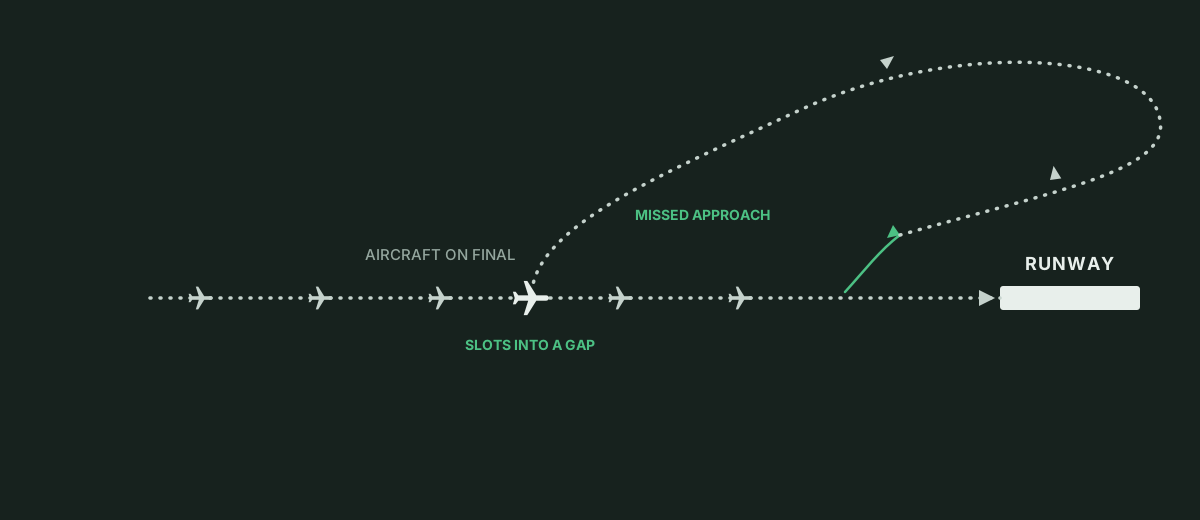
Once the aircraft is climbing safely at or above the minimum vectoring altitude, you turn it back into the pattern and fit it into the first gap in the arrival sequence that preserves separation. A routine go-around slots into the line where a space opens, and you must issue a new approach clearance when turning the aircraft back onto final.
When a pilot says unable
When a pilot says UnableUnable.A pilot says this when an instruction is unsafe or beyond the aircraft's capability, requiring a new clearance from you.Open in the glossary to an instruction, the pilot has the last word on what the aircraft can safely do. The pilot in command is responsible for the safety of the flight, and FAA procedures allow a pilot to refuse any speed assignment considered excessive or contrary to the aircraft's operating limits.
On approach, pilots say unable for several standard reasons. They refuse altitudes above the aircraft's ceiling or below safe terrain clearance, and speeds outside the airframe's operating envelope for its current weight. They refuse an ILS approach when the ILS is missing or out of service, a visual approach when weather hides the airport, and a three-sixty turn once established on the localizer. Pilots also refuse a runway when the tailwind or crosswind exceeds their limit, and they refuse holds or delaying turns when low on fuel or handling an emergency.
Delta Eight Eight, reduce speed to one seven zero knots, hold at RONBY as published.
Unable one seven zero knots, minimum clean speed is two one zero knots, and unable hold, minimum fuel, Delta Eight Eight.
Delta Eight Eight, roger, maintain two one zero knots, fly heading zero seven zero, vector for the downwind sequence.
Maintain two one zero knots, heading zero seven zero, Delta Eight Eight.
When a pilot says unable and states the reason, cancel the instruction that will not work and offer an alternative: a higher speed with longer vector miles, a different altitude, an RNAV approach, or the opposite runway.
Minimum fuel, Pan-Pan, and Mayday
Pilots use three standard calls to report fuel status and onboard trouble, and each asks for a specific level of help from approach control.
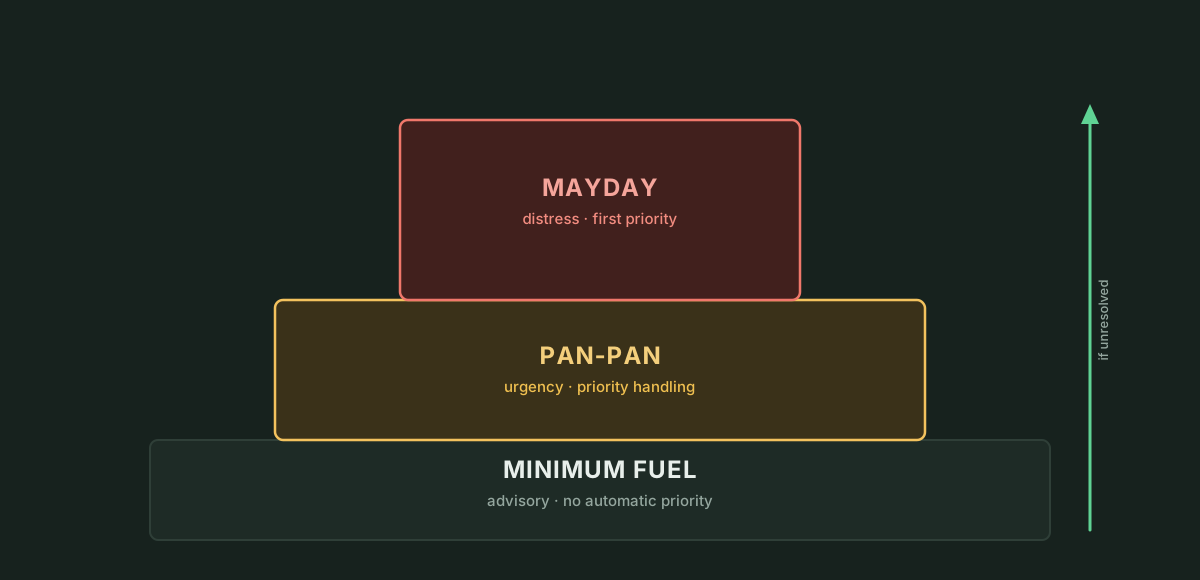
"Minimum fuel" means the flight's fuel supply has reached a state where the crew can accept no undue delay at the destination. The call is an advisory that carries no automatic traffic priority, warning you that an emergency is possible if undue delay occurs. You use common sense to keep the flight moving without extra delay, watch for congestion ahead, and pass the minimum fuel advisory to the tower or the next facility on handoff. If further delay threatens a safe landing, the pilot declares a fuel emergency and reports remaining fuel in minutes.
A pilot who encounters a Distress condition should declare an emergency by beginning the initial communication with the word "Mayday," preferably repeated three times. For an Urgency condition, the word "Pan-Pan" should be used in the same manner. If the words "Mayday" or "Pan-Pan" are not used but you believe an emergency or an urgent situation exists, handle it as though it were an emergency.
"Pan-panPan-pan, pan-pan, pan-pan.The urgency call: a serious problem, but not yet a distress. It outranks everything except a mayday.Open in the glossary, Pan-Pan, Pan-Pan" declares an urgency condition: the flight has a problem needing priority handling, though the aircraft is clear of immediate crash danger. "MaydayMayday, mayday, mayday.The distress call: the aircraft is in grave and imminent danger and needs priority over everything.Open in the glossary, Mayday, Mayday" declares distress: the flight is in grave and imminent danger and requires immediate assistance, such as an engine failure, a fuel emergency, or a passenger in cardiac arrest that the pilot has judged to be distress. Under FAA rules, you also treat an aircraft emergency as existing, and notify the centre or rescue coordination centre, when facility staff, the operator, or an automatic transmission declares it; when Radar contactAmerican Two One Five, radar contact.I have identified you on my display and will provide radar flight following. Said when identification is established, and the pilot can stop making position reports.Open in the glossary and radio communications are both unexpectedly lost; when a forced landing or crew bailout is reported; when code 7700 appears on the scope; when an intercept or ground rescue is needed; or when an emergency locator transmitter is heard. Because emergencies vary infinitely, you choose the action that best fits the situation.
Mayday, Mayday, Mayday, Bayview Approach, American Two One Five, passenger in cardiac arrest, request priority to two five right and medical on arrival.
American Two One Five, Bayview Approach, roger Mayday, turn right heading two two zero, descend and maintain three thousand, priority vector to runway two five right, medical will be waiting.
Right heading two two zero, descend and maintain three thousand, American Two One Five.
Southwest Eight Eight, turn left heading one six zero immediately, traffic on priority final.
Left heading one six zero, Southwest Eight Eight.
Once an aircraft is in an emergency, it gets handled first and without delay. You never hold it, send it around the pattern, or vector it away for spacing, and the tower alerts rescue services on the airport. Every other aircraft in your sector gets moved out of the emergency flight's way with vectors, altitude changes, speed reductions, or holds. Chapter 16 covers how the tower handles an emergency return to the field.
Wind shifts and changing the runway
Runways are chosen so aircraft land into the wind. Many airline operators accept at most about 10 knots of tailwind on landing, and aircraft also have crosswind limits. When the wind turns around, the tower and approach coordinate a runway change and update the ATIS with the new runway and a "runway change in progress" remark while the changeover is worked.
Aircraft already cleared for the old runway either land with whatever tailwind the pilot accepts, or get recleared, revectored, or sent around to the new runway. A pilot whose tailwind or crosswind limit is exceeded will call unable and request the opposite end.
Bayview Approach, United Four Four Seven, unable runway zero seven left, tailwind exceeds our limit, request runway two five right.
United Four Four Seven, roger, cancel approach clearance, climb and maintain four thousand, turn left heading one six zero, vector for runway two five right.
Climb and maintain four thousand, left heading one six zero for runway two five right, United Four Four Seven.
To complete the changeover, you cancel approach clearances for aircraft pulling off the old final, climb them to a safe vectoring altitude, and build a new arrival sequence aligned with the new runway.
Safety alerts, unclear calls, and lost radios
Issuing a safety alert is a first-priority duty whenever you see an aircraft at an altitude or position that places it in unsafe proximity to terrain, obstructions, or other aircraft.
Issue a safety alert to an aircraft if you are aware the aircraft is in a position/altitude that, in your judgment, places it in unsafe proximity to terrain, obstructions, or other aircraft. Once the pilot informs you action is being taken to resolve the situation, you may discontinue the issuance of further alerts. Do not assume that because someone else has responsibility for the aircraft that the unsafe situation has been observed and the safety alert issued; inform the appropriate controller.
For terrain or obstacles outside final approach, transmit: "Low altitude alert, (callsign), check your altitude immediately, the minimum vectoring altitude in your area is three thousand." For converging traffic, give the position and an immediate turn or climb: "Traffic alert, (callsign), twelve o'clock, two miles, advise you turn left heading one eight zero immediately." After you issue the alert, the pilot decides what action to take.
When any part of a radio call is unclear, say "Say againSay again for American Two One Five.Used instead of the military term 'repeat', this asks the other party to repeat their entire last transmission when it was broken or unclear.Open in the glossary" and have the pilot repeat it; never guess at an altitude or heading. Pilots do the same when your transmission is unclear, and if a pilot reads back a wrong number, correct it at once with "NegativeNegative.It means no, permission not granted, or that is not correct.Open in the glossary" and the restated clearance; a wrong ReadbackThe pilot repeating a clearance or instruction back so the controller can verify it was received correctly.Open in the glossary left uncorrected can become an altitude bust.
Southwest Eight Eight, descend and maintain four thousand.
Descend and maintain three thousand, Southwest Eight Eight.
Southwest Eight Eight, negative, descend and maintain four thousand.
Descend and maintain four thousand, Southwest Eight Eight.
If an aircraft stops answering on the radio, use every available channel to re-establish contact: emergency frequencies such as 121.5 MHz, navigation aid voice channels, Flight Service, and the airline's radio, broadcasting clearances over those links. You can ask the pilot to acknowledge on radar by squawking ident, selecting code 7600, switching the transponder to StandbyAmerican Two One Five, standby.Wait, something higher priority comes first; call again if the delay runs long. A standby is not a clearance and not an answer.Open in the glossary long enough to see the target drop, or making an observable turn, and you can broadcast a clearance to the filed alternate if the operator agrees. A pilot with a dead radio is expected to squawk 7600 and follow the standard lost-communications rules while you keep other traffic clear; after five minutes without contact, treat the activity as suspicious and report it to the supervisor.
In the Sim
In ATC Simulator, a pilot announces a go-around on the frequency with its cause, such as "going around, unstable approach". On an approach shift, the go-around you meet from your own vectoring is the unstable approach: arriving more than 600 feet above the glideslope inside three and a half miles, or flying more than 30 knots over final approach speed once on the glideslope. On a tower shift, an aircraft also goes around with no landing clearance inside one and a half miles, for traffic or a vehicle on the runway, when the landing would be too long, when the localizer or GPS signal is lost without the field in sight, at decision height in weather below minima, or on the tower's order ("Go aroundGo around, I say again, go around.An instruction or pilot decision to abandon the approach and climb straight ahead or on the missed approach, after which the aircraft is re-sequenced.Open in the glossary"). A go-around the controller could have prevented, such as an unstable approach or a tower order, costs 30 points; one caused by the simulation, such as weather, a lost signal, or no clearance given, costs nothing and is only counted.
After a go-around, the approach clearance is void and the aircraft is off the approach. It climbs straight ahead on the final course toward 4,000 feet, or flies the published missed approach where one exists; Bayview's Runway 25R uses "Bayview Two", climbing to 800 feet before turning right to RONBY at or below 4,000 feet, and you must clear the aircraft for the approach again. When weather is below minima on an approach shift, a share of the arrivals handed to the tower miss at decision height and return to your frequency three to five minutes later in their published missed approach hold. Each aircraft returns once and carries a four-minute clock; after four minutes the pilot asks to divert to the alternate, and "contact Center" clears the flight for 25 points, the same as an arrival.
Pilots refuse invalid instructions in words by saying "unable" with the reason: an altitude above the aircraft's ceiling or below the minimum vectoring altitude, a speed outside its envelope (clamped to what the aircraft can fly), an ILS approach with no ILS or with the ILS out of service, a visual approach below visual conditions, a three-sixty when established on the localizer, or a hold or three-sixty when low on fuel, in an emergency, or on priority ("unable delay, request priority"). They also refuse a runway with more than 10 knots of tailwind or a crosswind past their limit (15 knots for light aircraft, 25 knots for turboprops, 30 knots for jets, each reduced by 5 knots on a wet runway) and ask for the opposite end; a pilot already on an approach when the wind shifts past that limit reports it once unprompted. On an approach shift, the automated tower turns the field around when the wind favours the other runway, updating the ATIS letter and adding "Runway change in progress" until aircraft cleared for the old runway are worked or 15 minutes pass.
Fuel runs in minutes. At 35 minutes or less remaining (a 15-minute margin over a 20-minute reserve), the pilot calls "minimum fuel" as an advisory without priority. At 20 minutes or less, the pilot declares "Mayday, Mayday, Mayday, fuel emergency" with minutes remaining and souls on board, placing the flight on priority with a 10-minute deadline: handing the flight to the tower in time pays 50 points, and handing it over late costs 20 points. Scripted emergencies from the world director, such as a passenger in cardiac arrest on American Two One Five in the first emergency lesson, state their request ("request priority to two five right and medical on arrival") with a 600-second deadline and refuse holds.
A low altitude alert appears on the scope as a halo with a LOW mark and a log line naming the minimum vectoring altitude; it is unscored because a heading can walk a legal low aircraft into higher ground. Separation alerts show amber when predicted and red when broken. Radio failure and code 7600 are not modelled in the game. However, "say again" works both ways: you can tell a pilot "say again" to repeat the last call, and when the game cannot parse your transmission the pilot replies "say again for (callsign)", or "station calling, say again with your callsign" if no callsign was recognized. Pilots occasionally read a clearance back wrong; catching it earns points, "say altitude" or another query reports what the aircraft is doing, and an uncaught wrong readback plays out. Chapter 9 turns these situations into practice with lesson 11, "Runway change", and lesson 12, "Your first emergency".