Chapter 07
Sequencing & Sharing the Sky
Learn radar, vertical, and wake turbulence separation minima, how to build spacing between arrivals, and how to climb departures through arrival traffic.
What separation means
Working one arrival is a navigation problem: you point the aircraft toward the approach gate, step it down to the intercept altitude, and slow it to capture the localizer. When several arrivals and departures share the sector, navigation becomes secondary to separation. Every aircraft in your airspace must have a legal buffer of distance or altitude from every other aircraft at all times.
You separate instrument flight rules traffic with either vertical separation or lateral radar separation. They are alternatives. When two aircraft have the required vertical buffer, their radar targets can pass directly over one another. When they have the required lateral distance, they can fly at the same altitude. You lose separation only when both buffers fail at the same moment.
Separate instrument flight rules (IFR) aircraft using the following minima between altitudes: Up to and including FL 410- 1,000 feet.
In approach airspace, vertical separation is 1,000 feet. An arrival level at 6,000 feet is separated from a departure climbing to 5,000 feet. As soon as you clear the upper aircraft to descend out of 6,000 feet or the lower aircraft to climb above 5,000 feet, vertical separation ends because both occupy the altitude band in between. Lateral radar separation must exist before you issue that clearance.
In the terminal environment, the standard lateral radar minimum is 3 nautical miles when working within 40 miles of a single radar antenna. When working 40 miles or more from the antenna, when the system runs in multi-sensor mode, or when a target shows a reduced-accuracy indication, the minimum increases to 5 miles.
That 3-mile standard assumes calm air behind the leader. Every wing generates lift by creating high pressure below and low pressure above, rolling the air at the wingtips into counter-rotating vortices that sink and linger behind the flight path. A HeavyUnited Four Heavy, Bayview Approach.A wake-turbulence class carried in the callsign of aircraft able to take off at 300,000 pounds or more, because the wake they leave behind is a hazard to whoever follows.Open in the glossary or super airliner leaves a wake strong enough to overwhelm a smaller aircraft following at normal radar spacing.
Pilots of heavy and super aircraft add "heavy" or "super" after their callsign on the radio so you and trailing pilots know the vortex hazard is present. When an aircraft operates directly behind, or within 2,500 feet of and less than 1,000 feet below, a heavy or super aircraft, or follows it on an approach to the same runway, you must apply wake turbulence minima:
- Behind a heavy aircraft: 4 miles for a heavy, 5 miles for a large, and 6 miles for a small.
- Behind a large aircraft: 4 miles for a small aircraft.
- Behind a super aircraft: 5 miles for a super, 6 for a heavy, 7 for a large, and 8 for a small.
For two aircraft landing on the same runway, the wake minimum must exist at the moment the leader crosses the threshold.
When wake turbulence does not apply, aircraft established on the same final approach course within 10 miles of the runway may be spaced down to 2.5 miles when the conditions of FAA rules are met: wake minima still apply where required, average runway occupancy of 50 seconds or less is documented, and runway turnoffs are visible from the tower. Because of that rule, 3 miles is not the target gap at the threshold. You still build 3.5 to 4 miles outside the approach gate so that compression as the leader slows to final approach speed brings the pair down toward 2.5 miles at the runway without breaking the minimum.
Aircraft are on opposite/reciprocal courses and you have observed that they have passed each other; or aircraft are on same or crossing courses/assigned radar vectors and one aircraft has crossed the projected course of the other, and the angular difference between their courses/assigned radar vectors is at least 15 degrees.
Once two opposite-direction aircraft have passed on the scope, or two crossing aircraft have crossed with at least 15 degrees between their assigned courses, you can discontinue vertical separation and climb or descend them through each other's altitudes, provided wake turbulence minima do not apply.
Building spacing between arrivals
When several arrivals reach your sector within a few minutes of one another, your task is to arrange them into one orderly line with legal spacing between arrivals all the way to the runway.
Establish the sequence of arriving and departing aircraft by requiring them to adjust flight or ground operation, as necessary, to achieve proper spacing.
You have four tools to build spacing, used in order from least disruptive to most: speed control, radar vectors, delaying turns, and holding patterns. Reach for the smallest tool that does the job, and issue the instruction while there is still room for it to work.
Start with speed control, because it costs no track miles and keeps the aircraft on its route. Slowing a trailing arrival by 30 or 40 knots opens the gap steadily, though speed changes take time and distance to take effect. A speed reduction given 25 miles out solves a spacing problem quietly; the same reduction given 8 miles from the runway comes too late.
When speed alone is not enough, you lengthen or shorten the path over the ground by extending the downwind leg, angling an aircraft 20 or 30 degrees off course before turning it back toward final, or turning an arrival in early to fill an open gap.
Instructing an arrival on downwind to make a 360-degree turn buys about two minutes and 6 to 8 miles of spacing, at the cost of extra track miles.
When a stack of arrivals exceeds what vectors can absorb, you hold aircraft at a published arrival fix, separated by 1,000 feet vertically, and peel the bottom aircraft off the stack as slots open. Once the landing order is set, you also call the sequence so the trailing pilot knows who to follow.
American Two One Five, reduce speed to one eight zero knots.
Reduce speed to one eight zero knots, American Two One Five.
United Four Four Seven, number two, follow American Two One Five, reduce speed to one eight zero knots.
Number two, reduce speed to one eight zero knots, United Four Four Seven.
Delta Eight Eight, make a left three sixty for spacing.
Make a left three sixty for spacing, Delta Eight Eight.
Southwest Eight Eight, hold at RONBY as published.
Hold at RONBY as published, Southwest Eight Eight.
Merging two arrival streams
At Bayview, arrivals from the northwest on the RONBY One and arrivals from the southeast on the TISBA Three or HALME One must merge into one line for Runway 25R outside the approach gate.
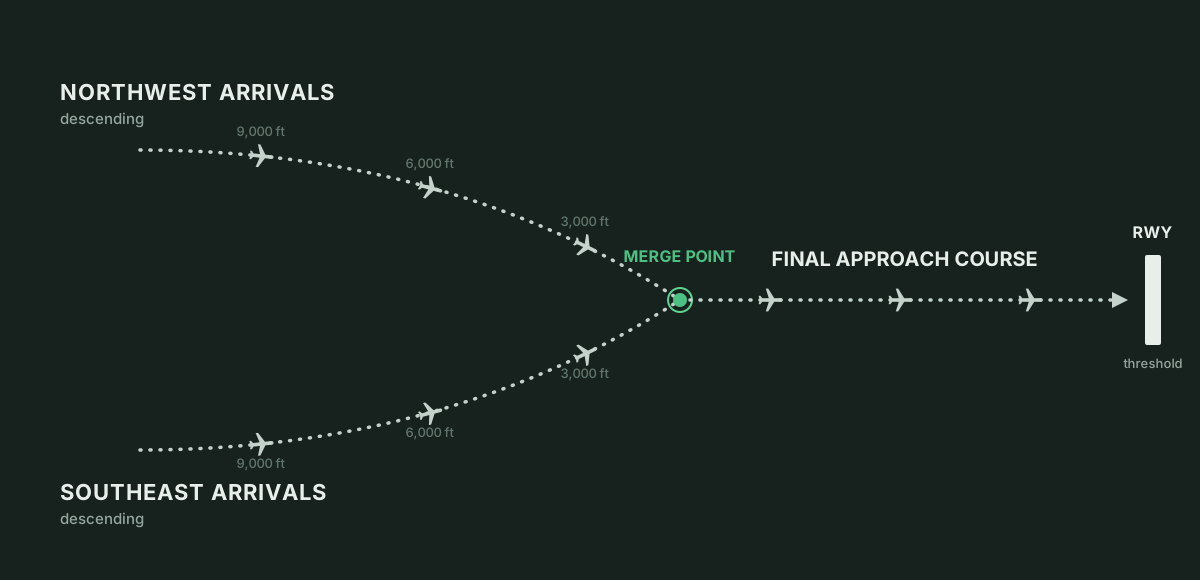
You must decide the landing order well before the two streams meet. Compare each aircraft's distance to the approach gate and its groundspeed; the aircraft that is further along or faster generally goes first. Once you choose number one, slow or vector the second stream right away to open the gap before both flights reach their base turns.
Aim for more than the minimum spacing at the merge point so that compression behind the slowing leader does not close the gap on final. When a large jet merges behind a heavy jet on Runway 25R, the wake minimum is 5 miles, so you build 6 to 6.5 miles at intercept.
Speedbird One Zero Heavy, turn right heading two two zero, descend and maintain three thousand, cleared ILS approach runway two five right.
Right heading two two zero, descend and maintain three thousand, cleared ILS approach runway two five right, Speedbird One Zero Heavy.
Alaska Five Two, reduce speed to one nine zero knots, turn left heading one nine zero.
Reduce speed to one nine zero knots, left heading one nine zero, Alaska Five Two.
Here Speedbird One Zero Heavy from the north takes the lead slot with a direct intercept turn, while Alaska Five Two from the south is slowed and angled onto a wider base heading until the wake gap opens.
Climbing departures through the arrival flow
Departures climb off the runway through the same airspace that arrivals descend through, and their tracks frequently cross.
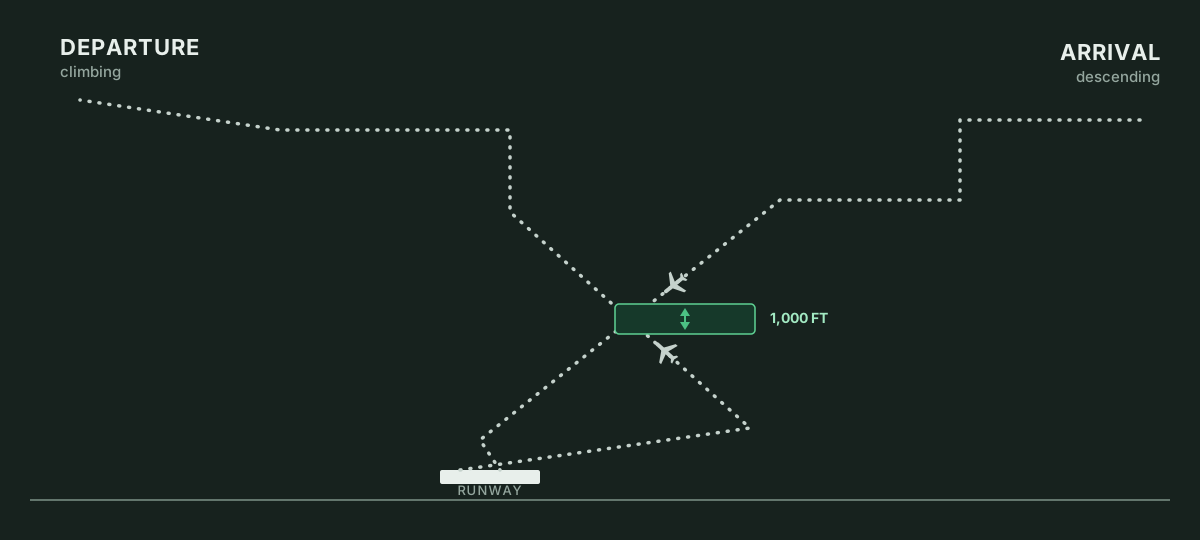
Altitude separation with the 1,000-foot minimum is the normal tool for crossing the two flows. If an arrival is descending at 6,000 feet across a departure's climb path, hold the arrival at 6,000 feet and stop the departure at 5,000 feet. When a departure cannot be given its filed altitude yet, tell the pilot what altitude to maintain and when to expect higher so the crew knows the restriction is temporary.
Once the targets pass or diverge by at least 15 degrees and the departure is clear of arrival traffic, restore its published climb with a "climb via" clearance and hand it off to Cascade Center.
Bayview Approach, United Three One Two, with you passing two thousand three hundred for five thousand.
United Three One Two, Bayview Approach, radar contact, climb and maintain five thousand, expect higher in two minutes.
Maintain five thousand, expect higher in two minutes, United Three One Two.
United Three One Two, climb via SID.
Climb via SID, United Three One Two.
United Three One Two, contact Cascade Center, one three three point six five.
Cascade Center, one three three point six five, United Three One Two.
Reading the scope ahead of the clock
Separation depends on where aircraft will be two and three minutes from now. Scan groundspeeds, vertical rates, and projected courses to spot conflicts while they are still building:
- A trailing arrival showing a groundspeed 30 knots faster than the leader on the same route.
- Two arrivals on converging base legs descending toward the same altitude.
- A fast departure climbing at 3,000 feet per minute toward a slow arrival crossing five miles ahead.
When you act early, three choices are cheap: a small speed change, a 15-degree turn, or a 1,000-foot altitude stop. Waiting until two targets are closing inside four miles leaves only an immediate vector, an altitude stop, or a safety alert (covered in chapter 8).
In the Sim
In ATC Simulator, a separation violation occurs when two aircraft are closer than the lateral minimum and within 1,000 feet vertically at the same moment. The base minimum is 3 miles; each bust costs 100 points, and the third violation of a shift ends the shift. The comm log records the pair, their distances at the bust, and the minimum that applied ("3 nm / 1000 ft", "4 nm for wake / 1000 ft", or "2.5 nm on the same final / 1000 ft"). On the scope, a predicted conflict appears in amber before becoming a red violation, projecting every pair along their current tracks and vertical rates for up to 120 seconds.
The simulator enforces the larger of radar and wake minima. Heavy aircraft and the A380 add "heavy" or "super" after their callsign on the radio. Wake minima by leader class then follower class are 5 miles for a super behind a super and 6 for a heavy behind a super; 4 miles for a heavy behind a heavy, 5 for a medium or turboprop behind a heavy, and 6 for a light behind a heavy; and 4 miles for a light behind a medium. Behind a super, the minimum is 7 miles for a medium, turboprop, or freighter and 8 for a light; behind a heavy, it is 4 miles for a super and 5 for a freighter. Every other pair uses 3 miles. Two aircraft established on the same final within 10 miles of the threshold use 2.5 miles unless a wake minimum applies. At KSFO, where Runways 28L and 28R are a declared parallel pair, two aircraft established on different finals of the pair are not alerted against each other, though an aircraft merely cleared for the approach is still being vectored and the 3-mile minimum applies.
Your spacing tools include speed commands (reduce, increase, resume normal), vectors, "number two, follow (callsign)", "make a left three sixty for spacing", and holds at a published fix ("hold at RONBY as published"). The touch interface provides the same tools through a SEQ button, a TURN row for a three-sixty, and a HOLD button. Because track miles beyond a small allowance deduct points, delays built with vectors and orbits cost in the score while speed adjustments alone do not.
"Number two" is advisory: the aircraft does not slow down to follow, and pilots refuse the call if the named traffic is not ahead of them, not an arrival, or not on the frequency, or once established on the localizer. A three-sixty is one full turn that rolls out on its starting heading while keeping the route and approach clearance; it is refused when established on the localizer ("established on the localizer, UnableUnable.A pilot says this when an instruction is unsafe or beyond the aircraft's capability, requiring a new clearance from you.Open in the glossary a three sixty"), already holding, short of fuel (minimum fuel or fuel emergency), or declared priority or emergency ("unable delay, request priority"). KBAY publishes right-turn, one-minute holds at RONBY, MIKSA, BEKRI, ASKIL, SOLAN, and KELVO, which are also refused when short of fuel or in an emergency. Each arrival is given its own level in the stack at its terminal fix when created and keeps it, so aircraft holding at the same fix never share an altitude.
On KBAY approach shifts, departures stop at the SID's published top of 5,000 feet (WESUM Two and OSDEX One) until climbed further; both "climb via SID" and "climb via SID except maintain five thousand" are accepted. Handing a departure to Cascade Center pays 15 points and sends it to the 15,000-foot sector ceiling. Once handed to Center, a computer departure controller keeps IFR departures on the same route apart so two handed-off departures are not alerted against each other, though a departure handed off against traffic you still control remains your responsibility. The training ladder covers these skills in lesson 9, "The departure", and lesson 10, "Sequencing".