Chapter 03
Radio & Phraseology
Learn how radio transmissions are built, how callsigns and numbers are spoken, and how the readback and hearback loop prevents errors on frequency.
Building a transmission and naming the players
Chapter 2 covered how headings, speeds, and altitudes are measured and how they appear on your radar scope. To put an aircraft onto any of those values, you speak the instruction over a shared VHF channel using standard phraseology so the crew understands it on the first listen.
Every initial radio transmission from a control position follows a fixed three-part order: whom you are calling, who you are, and what you want them to know or do.
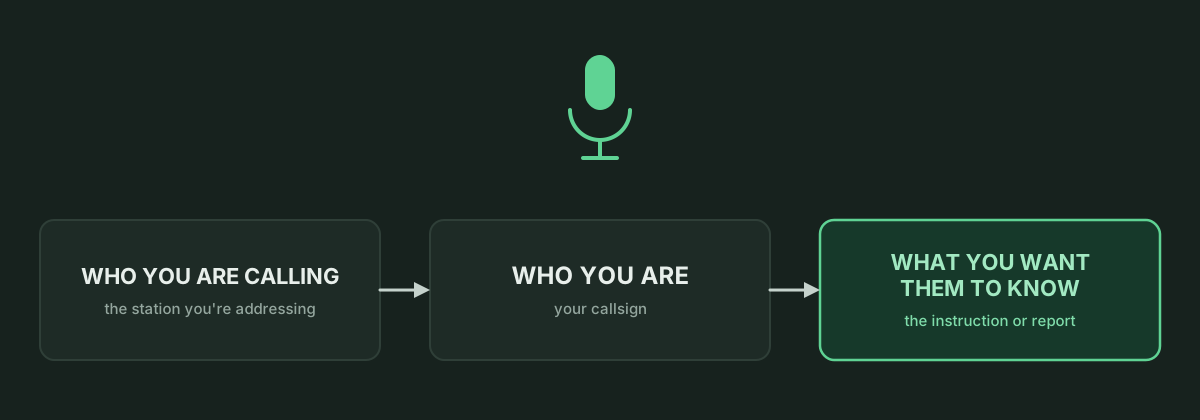
Use the following format for radio communications with an aircraft: Sector/position on initial radio contact: Identification of aircraft. Identification of ATC unit. Message (if any).
Subsequent radio transmissions from the same sector/position must use the same format, except the identification of the ATC unit may be omitted.
Leading with the aircraft's identity gets the right cockpit listening. Ten or fifteen crews may be monitoring your frequency while running checklists and talking on the intercom. Hearing their callsign first tells that crew to focus on the numbers; every other crew knows to ignore the call. On initial check-in, the pilot names your facility first and then gives their own identity. You answer with their aircraft identification, your facility identification, and your message. On later transmissions from the same sector, you may drop your facility name and start with the aircraft's callsign.
Air traffic facilities identify themselves by stating the airport or geographic name followed by the control function. Around Bayview International, you work as Bayview Approach, the cab works as Bayview Tower and Bayview Ground, and the overlying en route sectors work as Cascade Center. Across the country you hear the same pattern: Boston Departure, Denver Approach, Columbus Tower, Washington Center, and O'Hare Ground.
An aircraft's callsign depends on the operation. Airlines use an authorised ICAO telephony designator and the flight number, spoken in group form ("American Fifty-two") or as separate digits when single digits are clearer ("United Five One Seven", "American Two One Five"). Aircraft in the HeavyUnited Four Heavy, Bayview Approach.A wake-turbulence class carried in the callsign of aircraft able to take off at 300,000 pounds or more, because the wake they leave behind is a hazard to whoever follows.Open in the glossary or super wake turbulence categories add "heavy" or "super" to their callsign on initial contact.
US-registered civil aircraft without an airline designator use "November" followed by their registration digits and phonetic letters on initial contact, such as "November One Two Three Four Golf". Once two-way contact is established, you may shorten the callsign to the aircraft type or manufacturer and the last three characters ("Bonanza Three Four Golf") or just the last three characters. When similar-sounding callsigns are on the frequency, use the full identification for both.
Bayview Approach, American Two One Five, with you at one zero thousand.
American Two One Five, Bayview Approach, radar contact.
American Two One Five, descend and maintain six thousand.
Descend and maintain six thousand, American Two One Five.
Phonetics and how numbers are spoken
VHF aviation radios have narrow audio bandwidth, making spoken English letters like "B", "C", "D", "E", "G", "P", "T", and "V" sound alike through static. To spell navigation fixes, taxiways, or tail numbers without confusion, aviation uses the ICAO phonetic alphabet: Alfa, Bravo, Charlie, Delta, Echo, Foxtrot, Golf, Hotel, India, Juliett, Kilo, Lima, Mike, November, Oscar, Papa, Quebec, Romeo, Sierra, Tango, Uniform, Victor, Whiskey, X-ray, Yankee, and Zulu.
Numbers are spoken digit by digit, and four digits use modified radio pronunciations so they carry cleanly over a weak link: three is "3treeSpoken tree so it cannot melt into free or be lost to a th- sound a non-native speaker does not have.Open in the glossary", four is two-syllable "4fowerTwo syllables, so it cannot be confused with for.Open in the glossary", five is "5fifeThe soft v ending of five drops out under static, so the spoken form ends in a hard f instead.Open in the glossary", and nine is "9ninerTwo syllables, so it cannot be confused with five, or with the German nein.Open in the glossary". Zero, one, two, six, seven, and eight use their normal English pronunciations, and 0 is spoken as "zero".
The number "0" as "zero" except where it is used in approved "group form" for authorized aircraft call signs, and in stating altitudes.
Altimeter setting. The word "altimeter" followed by the separate digits of the altimeter setting.
Heading. The word "heading" followed by the three separate digits of the number of degrees, omitting the word "degrees." Use heading 360 degrees to indicate a north heading.
Runways. The word "runway," followed by the separate digits of the runway designation. For a parallel runway, state the word "left," "right," or "center" if the letter "L," "R," or "C" is included in the designation.
Each category of operational number uses a standard framing pattern:
- Serial numbers and beacon codes: separate digits, such as "two one zero zero" for code 2100.
- Altitudes: each digit then "thousand" or "hundred" ("one zero thousand", "one seven thousand niner hundred"), or group form ("ten thousand").
- Flight levels: "flight level" and three separate digits, such as "flight level one eight zero".
- Headings: "heading" and three digits, such as "heading zero tree zero", "heading two fower zero", or "heading tree six zero" for north.
- Speeds: separate digits followed by "knots", such as "two fife zero knots" or "one eight zero knots".
- Frequencies: separate digits with "point" and at most two decimal digits ("one one eight point tree" for 118.30, "one tree tree point six fife").
- Runways: "runway" and separate digits plus "left", "right", or "center" ("runway two fife right", "runway tree tree").
- Altimeter: "altimeter" and four separate digits, such as "altimeter tree zero zero one".
- Wind: "wind", direction in tens of degrees, "at", and speed ("wind two seven zero at one fife").
Readback, hearback, and standard words
Until a pilot acknowledges a transmission, you cannot know whether the crew heard you or will comply.
Ensure pilots acknowledge all Air Traffic Clearances and ATC Instructions. When a pilot reads back an Air Traffic Clearance or ATC Instruction: Ensure that items read back are correct. Ensure the read back of hold short instructions, whether a part of taxi instructions or a LAHSO clearance. Ensure pilots use call signs and/or registration numbers in any read back acknowledging an Air Traffic Clearance or ATC Instruction.
When a pilot repeats an instruction back to you with their aircraft identification, that repetition is called the ReadbackThe pilot repeating a clearance or instruction back so the controller can verify it was received correctly.Open in the glossary. Your active listening check of that repetition against the clearance you issued is called HearbackThe controller's half of the loop: actually listening to the readback and catching the one that came back wrong.Open in the glossary. This closed loop of instruction, readback, hearback, and correction is the main error trap in air traffic control.
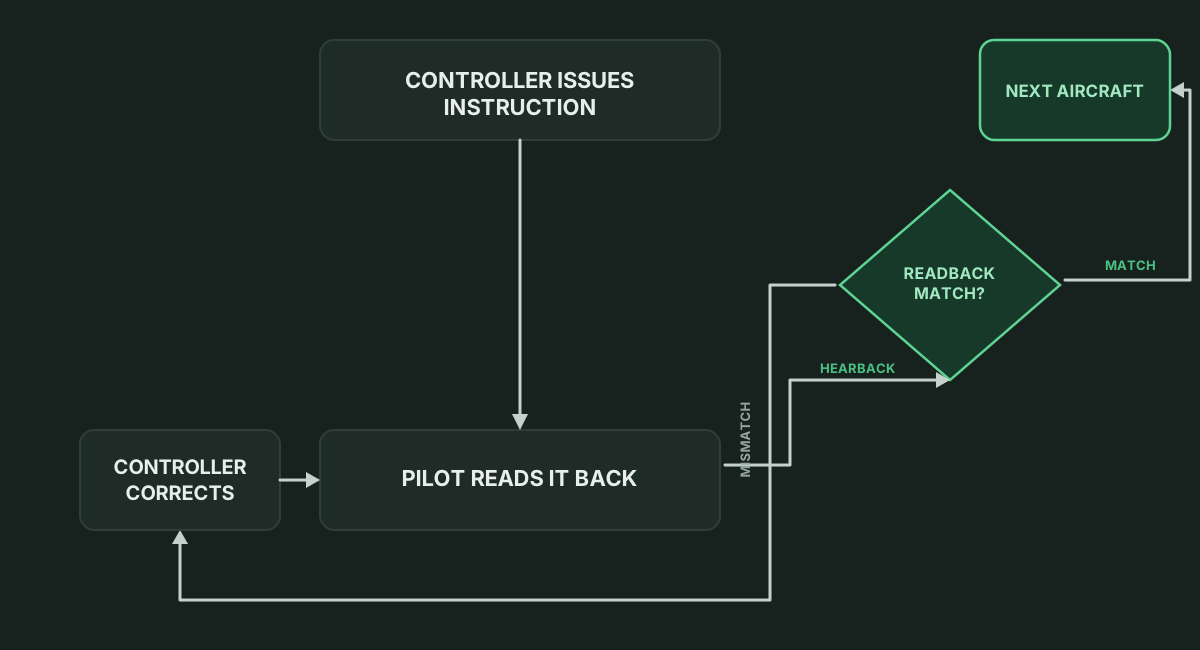
Pilots may acknowledge advisories using their callsign and "WilcoWilco.I received your instruction and will comply. Stronger than roger; still not a readback of the numbers.Open in the glossary", "RogerRoger.I received your whole transmission. It does not mean yes, and it is not a readback.Open in the glossary", or "AffirmativeAffirmative.Yes. US practice keeps the full word; ICAO shortened it to affirm so a clipped transmission cannot be heard as negative.Open in the glossary". When you issue a control instruction, listen for the numbers and critical limits: headings, altitudes, speeds, frequencies, runway assignments, and any hold-short instructions, along with the aircraft's callsign confirming the intended crew answered. If a pilot reads back a wrong value, key the microphone right away, state the callsign, say "NegativeNegative.It means no, permission not granted, or that is not correct.Open in the glossary", and reissue the complete correct instruction, then listen for a clean second readback.
Delta Four Eight Two, descend and maintain five thousand.
Descend and maintain four thousand, Delta Four Eight Two.
Delta Four Eight Two, negative, descend and maintain five thousand.
Descend and maintain five thousand, Delta Four Eight Two.
Alongside clearances, controllers and pilots use standard prowords with fixed meanings:
- "Roger": I have received all of your last transmission (never used to mean "yes").
- "Wilco": I have received your message, understand it, and will comply with it.
- "Affirmative": yes, or permission granted.
- "Negative": no, permission is not granted, or that is not correct.
- "UnableUnable.A pilot says this when an instruction is unsafe or beyond the aircraft's capability, requiring a new clearance from you.Open in the glossary": cannot comply with an instruction or request; requires an alternative plan.
- "StandbyAmerican Two One Five, standby.Wait, something higher priority comes first; call again if the delay runs long. A standby is not a clearance and not an answer.Open in the glossary": wait and keep listening while I finish a higher-priority call or coordination.
- "Correction": precedes a restated phrase when you misspeak ("correction, heading two five zero").
- "Disregard": cancels a transmission that you started in error.
The core instructions you use all shift
Most of your work in an approach room or tower cab is built from five groups of clearances: heading, altitude, speed, direct routing or holding, and frequency handoffs.
For lateral steering, state the turn direction and the three-digit magnetic heading, such as "turn left heading two four zero". Including the turn direction keeps the pilot from turning the long way around the compass. To stop a turn or keep an aircraft on its current track, issue "fly present heading". For a relative adjustment, issue "turn twenty degrees right".
For vertical movement, pair the direction of change with "and maintain" and the target altitude, such as "descend and maintain five thousand". For speed control, state the action and the three-digit speed in knots, such as "reduce speed to one eight zero knots".
To send an aircraft straight to a fix (covered in Chapter 4), issue "proceed direct RONBY". To park an arrival in a charted holding pattern at a fix, issue "hold at RONBY as published".
When a flight is ready to move to the next controller, issue a communications handoff by stating "contact", the next facility's name, and the frequency: "contact Bayview Tower, one one eight point three" or "contact Cascade Center, one three three point six five". The pilot reads back the facility and frequency before switching radios. Keep watching the target on your scope until the pilot checks in with the next controller or exits your airspace.
United Three Three Two, turn left heading two four zero.
Left heading two four zero, United Three Three Two.
Southwest Eight Eight, contact Bayview Tower, one one eight point three.
Contact Bayview Tower, one one eight point three, Southwest Eight Eight.
Keep transmissions short. Giving one instruction at a time per aircraft is the beginner's rule; more than three items in one transmission invites error. Think through what you are going to say before keying up so you do not hold the frequency open with a pause.
Party line listening and radio trouble
Aviation VHF frequencies are simplex channels: only one transmitter can occupy the frequency at a time, and every radio tuned to the channel hears every word spoken. Pilots use this party line listening to build a mental picture of the traffic around them, hear what winds or ride conditions crews ahead are reporting, and anticipate your instructions. On your side, listening to the frequency lets you catch readbacks, pilot requests, and calls that were blocked by another transmission.
Because the channel is shared, listen before keying up, never talk over an active transmission, and expect to wait your turn. Two transmissions at once block each other with a squeal or garbled audio, so a call that gets no answer is worth repeating.
When a transmission comes through cut off or too garbled to understand, reply with "Say againSay again for American Two One Five.Used instead of the military term 'repeat', this asks the other party to repeat their entire last transmission when it was broken or unclear.Open in the glossary". Never guess at a garbled callsign or altitude. If you need one specific value from a crew, ask for it with "say altitude", "say heading", or "say airspeed". And when a crew suspects transmitter trouble and calls "how do you read" for a radio check, reply with their readability on a scale from one (unreadable) to five (perfectly readable), such as "reading you five".
Bayview Approach, United Three Three Two, how do you read.
United Three Three Two, Bayview Approach, reading you five, say altitude.
Maintain seven thousand, United Three Three Two.
In the Sim
In ATC Simulator, every transmission on your frequency is voiced out loud, including check-ins, readbacks, requests from other aircraft, and the ATIS broadcast. The party line plays one transmission at a time. Your active exchange (your call and the pilot's readback answering it) takes priority over routine calls from other flights, while urgent transmissions such as an "unable" refusal, a go-around, or an emergency go first. You hold the transmit pad to talk, and the Push-to-talk setting lets you choose between hold-to-transmit and tap-to-latch.
Aircraft are addressed by their airline telephony and flight number spoken digit by digit, such as "American two one five" or "Southwest eight eight". US civil registrations are accepted in abbreviated form, and the wake words "heavy" and "super" are understood and dropped. If you speak the wrong airline name while the digits match your selected aircraft, the simulator routes the call to that selected aircraft. At Beginner and in lessons, a transmission spoken without a callsign goes to the selected aircraft or the sole aircraft on frequency; at Advanced and Expert, the callsign is required.
Where the simulator differs from the real job, your calls start with the aircraft's callsign and go straight to the instruction. Adding your own facility name after the callsign ("Bayview Approach, ...") is optional and understood, though calls framed that way do not earn the standard-phraseology bonus. Stating another facility's name prompts a correction from the pilot.
The recogniser accepts all standard forms taught in this chapter: headings ("turn left heading two four zero", "fly present heading", "turn twenty degrees right"), altitudes ("descend and maintain five thousand" and shorter forms), speeds ("reduce speed to one eight zero knots"), direct routing ("proceed direct RONBY"), holding ("hold at RONBY as published"), handoffs ("contact Bayview Tower, one one eight point three", "contact Cascade Center, one three three point six five"), "Radar contactAmerican Two One Five, radar contact.I have identified you on my display and will provide radar flight following. Said when identification is established, and the pilot can stop making position reports.Open in the glossary", "say again", and queries like "say altitude". Fixes are matched by sound, and the spoken number words "niner", "tree", "fower", and "fife" are accepted. Saying "correction" inside a call replaces the earlier part with the restated phrase. If nothing in your call is understood, the pilot replies "say again", and "how do you read" is answered "reading you five". Non-standard shorthand like "direct RONBY" and plain English also work, while an accepted standard form earns 5 points per transmission. The phrase card (the "?" beside the pad) lists the standard forms with the airport's fixes and runways.
Pilots read back instructions with their callsign last, such as "speed one eight zero knots, American two one five", "direct RONBY, American two one five", or "contact Bayview Tower, one one eight point three, American two one five". Pilots mishear an instruction about 2 percent of the time at Advanced and 5 percent at Expert, with no errors at Beginner, on priority or emergency flights, or when speech recognition confidence was low. A wrong readback has an error in one field; reissuing the original value within about twenty seconds of the end of the readback (such as "negative, descend and maintain five thousand") catches it for 20 points, while an uncaught error plays out and appears in the debrief as missed. Radio School offers two shelves of drills: Pilot (you read back and make calls) and Controller (hearback drills where you issue clearances and catch bad readbacks).