Chapter 10
In the Cab
Step into the control tower cab at Bayview to learn what the local controller owns, how the runway is selected, and how the strip board works.
The local controller and the active runway
In the first eight chapters, you sat at the radar scope as Bayview Approach on one two four point six, taking arrivals from Cascade Center, spacing them onto final, and handing them off to Bayview Tower on one one eight point three. Chapter 9 mapped the training ladder from that radar room up to the control tower. Now you sit in the cab on the receiving end of that handoff.
The airport traffic control tower is a glass room at a height that gives a clear view of the runways, taxiways, and final approach course. Inside the cab, Bayview Ground manages the movement areas off the active runways and taxis aircraft between the ramps and the Holding pointThe marked position at the runway entrance where a departure waits for its clearance. Crossing the marking without one is a runway incursion.Open in the glossary. The seat you occupy on one one eight point three is Local controlThe tower position that owns the active runway and the sky immediately around it; Tower on the radio. Every use of the runway happens on its say-so.Open in the glossary, and the local controller owns the active runways and the immediate airspace around the field.
The runway is the scarcest resource on the airport because a single strip of pavement can serve only one movement at a time. A landing aircraft occupies it from the threshold until it is clear at an exit; a departing aircraft occupies it from line-up until it is airborne and far enough down the runway; an aircraft or vehicle crossing occupies it too. Each clearance assumes the runway will be clear when the aircraft reaches it.
The local controller has primary responsibility for operations conducted on the active runway and must control the use of those runways.
Ground control must obtain approval from local control before authorizing an aircraft or a vehicle to cross or use any portion of an active runway.The coordination must include the point/intersection at the runway where the operation will occur.
The ground controller must advise the local controller when the coordinated runway operation is complete. This may be accomplished verbally or through visual aids as specified by a facility directive.
Ground controlThe tower position that owns the taxiways. It delivers departures to the holding point and takes arrivals back once they are clear of the runway.Open in the glossary must get the local controller's approval before letting an aircraft or vehicle cross or use any part of an active runway, naming the point at the runway where it will happen. The local controller's authorization uses the word "cross", the runway, and the point, and the ground controller reports back when the crossing is done. The local controller also coordinates with ground before using a runway not previously designated active. In the game, an aircraft holding short of an active runway requests the crossing on the tower frequency, and the local controller clears it across in the same form.
Bayview Tower, JetBlue Eight One, holding short of runway three three at alpha, request crossing.
JetBlue Eight One, Bayview Tower, cross runway three three at alpha.
Cross runway three three at alpha, JetBlue Eight One.
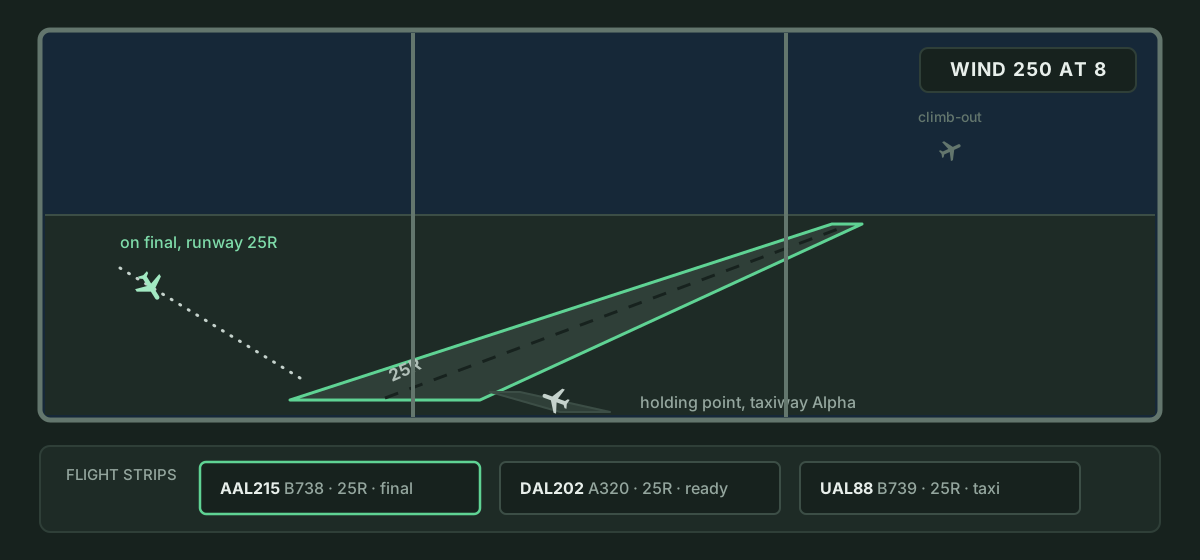
Selecting the runway in use
Before a clearance goes out on the frequency, the tower designates which runway is active.
The ATCT supervisor/controller-in-charge (CIC) determines which runway/s are designated RUNWAY IN USE/ACTIVE RUNWAY/DUTY RUNWAY.
Tailwind and crosswind considerations take precedence over delay/capacity considerations, and noise abatement operations/procedures/agreements.
The tower supervisor or controller in charge decides which runway or runways are the runway in use. The assignment is the runway most nearly aligned with the wind when the wind is five knots or more, or the calm-wind runway when it is under five knots. Operating into a headwind lowers groundspeed and shortens both the takeoff roll and the landing rollout.
Another runway may be assigned in winds of five knots or more if it is operationally advantageous or a Runway Use Program is in force. Tailwind and crosswind still come before delay, capacity, and noise abatement. A pilot who prefers another runway is expected to say so, and ATC may honour it as soon as practical while advising when a requested runway is noise-sensitive.
Bayview's intersecting pavements form four runway ends: two five right, zero seven left, three three, and one five. With the wind from two five zero at eight knots, runway two five right aligns into the wind and serves as the active runway.
Who calls the tower
Aircraft reach your frequency from two neighbours: Bayview Approach sends arrivals down final, and Bayview Ground sends departures to the holding points.
An arrival reaches the local controller from approach, already established on the final approach course and cleared for the approach. That approach clearance authorizes the pilot to fly the instrument procedure down final, such as the ILS for runway two five right. The arrival still needs a landing clearance from the tower. The pilot checks in on one one eight point three with the position and the approach flown. If the runway ahead is still occupied, you give the wind and instruct the pilot to Continue approachContinue approach, wind two five zero degrees eight knots.Keep flying the approach; the landing clearance is still to come. It authorizes nothing about the runway.Open in the glossary.
Bayview Tower, Delta Two Zero Two, ILS runway two five right.
Delta Two Zero Two, Bayview Tower, runway two five right, continue, wind two five zero at eight, traffic departing ahead.
Continuing approach, Delta Two Zero Two.
Telling an arrival to continue approach confirms radio contact and keeps the flight descending on final while you clear the runway ahead. Chapter 12 covers landing clearances and exits.
A departure reaches the local controller from ground control at the runway holding point, such as taxiway Alpha for runway two five right. Holding short at the bar, the pilot switches to the tower and calls ready for departure. When landing traffic is on short final, you instruct the departure to Hold shortStop before the runway's holding position marking and do not enter. Hold short instructions must be read back.Open in the glossary of the runway.
Bayview Tower, United Four Four Seven, holding short of runway two five right, ready for departure.
United Four Four Seven, Bayview Tower, hold short of runway two five right, landing traffic on short final.
Hold short of runway two five right, United Four Four Seven.
Once a gap opens, you line the departure up or clear it for takeoff, as covered in Chapter 11. After takeoff, the local controller hands the flight to departure on Bayview Approach's frequency; after landing, the local controller gives the exit and hands the flight to ground.
Scanning the surface
The tower controller works by sight. Aircraft on final have been established by approach, and your tools in the cab are the window, the radio, the wind indicator, and the strips.
Local controllers must visually scan runways to the maximum extent possible. Ground control must assist local control in visually scanning runways, especially when runways are in close proximity to other movement areas.
Before you issue any clearance, scan the full length of the runway from threshold to departure end and check every taxiway intersection along its edges. Confirm that the previous arrival has passed the hold-short bars at its exit, that no departure is waiting on the threshold, and that nothing is crossing downfield. Then check final approach to judge the distance of the next arrival. Ground control helps scan the runways, especially where runways sit close to parallel taxiways and other movement areas.
The strips record the clearances you have already issued. Looking at the runway before speaking catches the arrival that rolled past its turnoff or the departure that was slow to spool up. Chapter 13 covers go-arounds, rejected takeoffs, incursions, and the ground radar.
Reading the strip board
Flight progress strips are the controller's memory and carry the plan for the next ten minutes, whether a tower uses paper strips in holders or electronic strips on a screen. Each flight has one strip on the strip board showing its callsign, aircraft type, runway, and status, arranged in vertical bays by sequence.
A busy tower keeps arrivals and departures in separate bays on the strip board. Arrivals sit ordered by distance from the runway, and departures sit in intended takeoff order. Moving a strip changes the plan, so sliding one departure strip above another updates the sequence before you issue a clearance.
Cocking a strip sideways in its holder is the standard way to flag it for attention. A cocked strip reminds you during each scan of the strip board that the flight needs a call, and you push it flush again once the action is complete.
In the Sim
A fresh install of ATC Simulator starts on a tower shift at Bayview at Beginner. From the cab on one one eight point three with the runway in sight, you take arrivals from Bayview Approach on one two four point six, issue hold-short, takeoff, and landing clearances, and keep the gaps on the runway. The window shows a three-dimensional view from the tower's position with each aircraft labelled by callsign, and you select an aircraft by tapping it in the window or tapping its strip in the row across the top. The first tower lesson is titled "In the cab" and places one arrival, Delta Two Zero Two, seven miles out on the ILS for runway two five right with the wind from two five zero at eight. It teaches you to select the aircraft, wait, look at the runway first, clear it to land with runway, wind, and clearance, and send it to ground after it VacateLeave the runway. An aircraft is clear of the runway once all of it is past the holding position marking, and the pilot is the one who determines it.Open in the glossary.
A ground choice comes with the tower seat. In Separate mode, a ground controller taxis the aircraft, so departures reach the holding point ready and arrivals switch to ground after vacating, though every runway crossing still needs your clearance. In Combined mode, you work ground too, as covered in Chapter 14.
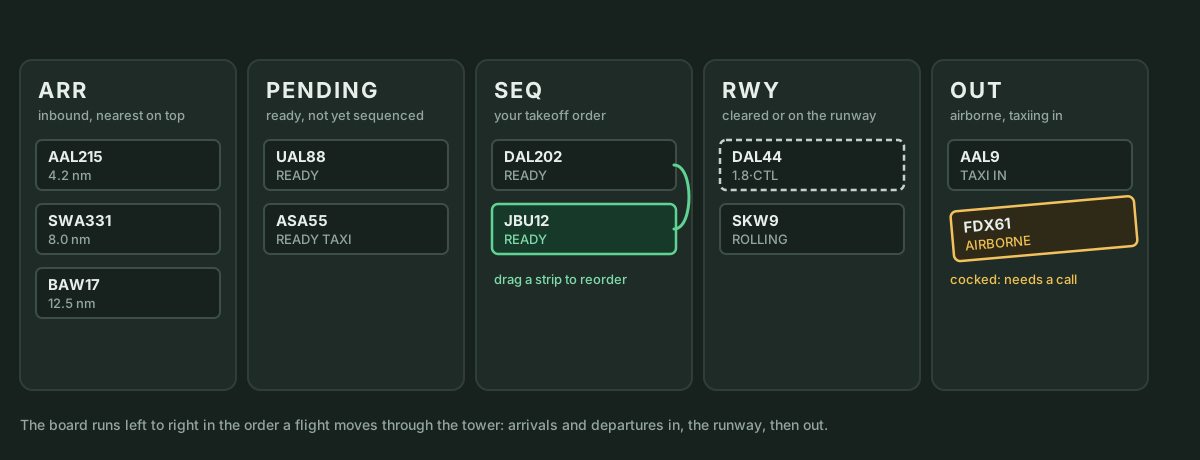
The game's strip board has the five bays shown in the figure, labelled ARR, PENDING, SEQ, RWY, and OUT, beneath a header showing the wind, the runways in use, and any change.
- ARR holds arrivals ordered by distance from the runway, nearest first, each strip showing its distance in miles.
- PENDING holds departures that have called ready at the holding point until you put them in the plan.
- SEQ holds planned departures in takeoff order.
- RWY holds whatever is on the runway or cleared onto it; an arrival Cleared to landRunway two five right, cleared to land.The runway is yours to land on. It may be issued while the aircraft ahead is still clearing, on the judgement that the runway will be free at the threshold.Open in the glossary moves there before its wheels touch as a reserved outline showing its distance and CTL.
- OUT holds flights that have left the runway but still matter: airborne departures until handoff, go-arounds, and arrivals taxiing in, held short, or crossing a runway.
Dragging strips in PENDING and SEQ changes the takeoff order. The reorder is your own plan and sends no radio call, and nothing can be dragged onto the runway because only clearances put an aircraft there. A strip is cocked to flag it for attention when the aircraft needs the tower: a departure has called ready at the holding point, an arrival is inside four miles without a landing clearance (inside two miles once told to continue), a departure is climbing out and needs the handoff, an arrival has gone around, or an arrival is clear of the runway or stopped on it and needs the turnoff and the handoff to ground. Selecting the strip acknowledges the flag; if the condition is still true later it flags again.
Strips turn amber or red when the runway-incursion check flags two aircraft on one runway. A Runway incursionAnything on protected runway surface that should not be there: an aircraft past its hold line, a vehicle without approval. The accident category towers exist to prevent.Open in the glossary costs 100 points and counts as a strike together with separation violations, and clearing landing traffic onto an occupied runway is one. Pilots also have a lookout: a pilot at the bar or on short final who can see traffic on the runway they were cleared onto may refuse or Go aroundGo around, I say again, go around.An instruction or pilot decision to abandon the approach and climb straight ahead or on the missed approach, after which the aircraft is re-sequenced.Open in the glossary 80 percent of the time at Beginner, 55 percent at Advanced, and 30 percent at Expert. At Expert, the ready room tells you to check the runway yourself before every clearance.