Chapter 11
Getting Them Airborne
Move aircraft from the holding point to departure control using line up and wait, standard takeoff clearances, arrival-gap timing, and roll cancellations.
Three choices at the holding point
When Ground controlThe tower position that owns the taxiways. It delivers departures to the holding point and takes arrivals back once they are clear of the runway.Open in the glossary finishes taxiing an outbound flight, the pilot stops behind the hold-short bars at the approach end of the active runway and switches to the tower frequency. At Bayview International, the departure queue forms on taxiway alpha at the threshold of Runway 25R. Under FAA rules, turbine-powered aircraft may be considered ready for takeoff when they reach the runway unless the crew advises otherwise.
When the aircraft at the front of the departure queue calls ready, you have three options:
- Hold the aircraft short behind the hold bars when the runway is occupied with no immediate gap opening, or when wake turbulence or route spacing requires a wait on the taxiway.
- Authorise the aircraft to Line up and waitRunway two five right, line up and wait.Taxi onto the runway and stop on the centerline, staged for an imminent departure. It is not a takeoff clearance, and pilots treat the difference as absolute.Open in the glossary on the centreline so it is aligned and ready to roll the moment the pavement ahead clears.
- Clear the aircraft for takeoff directly from the Holding pointThe marked position at the runway entrance where a departure waits for its clearance. Crossing the marking without one is a runway incursion.Open in the glossary when the runway, the departure path, and final approach are clear.
A departure does not need to stop on the centreline before being cleared to go. When the preceding aircraft has separation, final is open, and no wake or route timer is running, issue the takeoff clearance directly from the holding point. The pilot will cross the hold bars, turn onto the centreline, and advance power in one continuous motion.
Sometimes you need to deliver or amend an ATC clearance while a flight is waiting to depart. Whenever that aircraft is holding short of a runway or holding in position on a runway, FAA procedures require an explicit hold instruction at the end of the call: append "Hold shortStop before the runway's holding position marking and do not enter. Hold short instructions must be read back.Open in the glossary of runway" if the aircraft is behind the hold bars, or "hold in position" if it is on the centreline. Those words prevent a crew from mistaking a route or altitude amendment for permission to enter the runway or begin the takeoff roll.
Line up and wait
When traffic prevents an immediate takeoff clearance, you can stage the next departure on the runway using line up and wait (LUAW).
The intent of LUAW is to position aircraft for an imminent departure. Authorize an aircraft to line up and wait, except as restricted in subparagraph g, when takeoff clearances cannot be issued because of traffic. Issue traffic information to any aircraft so authorized. Traffic information may be omitted when the traffic is another aircraft which has landed on or is taking off the runway and is clearly visible to the holding aircraft. Do not use conditional phrases such as "behind landing traffic" or "after the departing aircraft."
Moving a jet from the hold bars onto the centreline takes about fifteen seconds or more as the crew releases the brakes, turns ninety degrees, and centres the nosewheel. Waiting behind the hold line until a landing aircraft turns off takes those fifteen seconds out of your arrival gap. Line up and wait overlaps that slow taxi with the roll-out of the aircraft ahead so the takeoff roll can start as soon as the arrival clears the runway.
Bayview Tower, United Four Four Seven, holding short of runway two five right, ready for departure.
United Four Four Seven, Bayview Tower, runway two five right, line up and wait, traffic a Boeing seven three seven on a five mile final.
Runway two five right, line up and wait, United Four Four Seven.
The phraseology states the runway first, then the instruction: "runway two five right, line up and wait." Conditional phrases such as "behind landing traffic" or "after the departing aircraft" are forbidden because a pilot might misidentify which aircraft to follow and taxi onto the runway in front of a jet moving at high speed. Hold the instruction until the conditioning aircraft passes the holding point, verify the runway visually, and then issue an unconditional clearance.
An aircraft should not remain in LUAW status for more than 90 seconds without additional instructions. Because an aircraft in position occupies the pavement an arrival needs, facilities without a full-configuration safety logic system must not clear an aircraft to land on a runway while another is holding in position or taxiing to LUAW until the departure has exited the runway or started its takeoff roll. At facilities without the full safety logic, you also must not authorise LUAW after a landing clearance has been issued on that runway; Chapter 12 covers the arrival side of this rule. Whenever you authorise LUAW, inform the departure of the closest traffic within six flying miles landing on the same runway.
Several visibility and layout rules also govern LUAW:
- Do not authorise LUAW when the departure point is not visible from the tower unless ground radar verifies the aircraft's position or the runway is used for departures only; never when the intersection is not visible.
- Do not line up multiple aircraft simultaneously on the same runway between sunrise and sunset unless a local assist or local monitor position is staffed.
- Between sunset and sunrise, only one aircraft at a time may line up at an intersection, and only on a departure-only runway under an approved facility directive.
- At an intersection, state the taxiway designator: "runway two five right at golf, line up and wait." When aircraft wait at both the threshold and an intersection, state "full length" for the threshold departure.
- When a runway is temporarily or permanently shortened before the Chart Supplement updates, omit "full length" and state "shortened" after the runway number: "runway two five right shortened, line up and wait."
The takeoff clearance
Once the runway is clear and separation is met, you clear the aircraft to depart.
When issuing a clearance for takeoff, first state the runway number followed by the takeoff clearance.
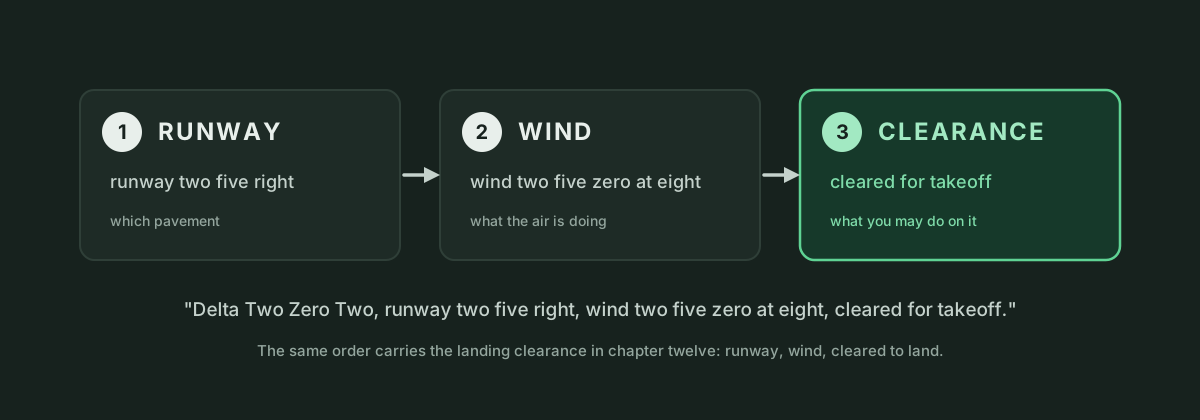
Stating the runway number first confirms which surface is active before the crew hears "Cleared for takeoffRunway two five right, wind two five zero at eight, cleared for takeoff.The runway is yours to fly from. Runway number first, then the wind, then the clearance, always in that order.Open in the glossary". The surface wind goes between the runway and the clearance. In FAA Order 7110.65, military towers issue the surface wind inside every takeoff clearance ("runway two five right, wind two five zero at eight, cleared for takeoff"), while civil towers normally provide the wind through the ATIS and on request. Including the wind inside the clearance is the standard habit taught in ATC Simulator.
United Four Four Seven, runway two five right, wind two five zero at eight, cleared for takeoff.
Runway two five right, cleared for takeoff, United Four Four Seven.
Bayview Tower, JetBlue Eight One, holding short of runway two five right, ready for departure.
JetBlue Eight One, runway two five right, wind two five zero at eight, cleared for takeoff.
Runway two five right, cleared for takeoff, JetBlue Eight One.
Here, United Four Four Seven rolled from LUAW once traffic cleared, and JetBlue Eight One was cleared directly from the holding point on alpha because the runway and final were open.
Location modifiers follow the same pattern as LUAW: intersection departures name the intersection ("runway two five right at golf, cleared for takeoff"), full-length departures state "full length" when another aircraft waits at an intersection, and reduced runways add "shortened" after the runway number. Every runway along the taxi route must be crossed before you issue the takeoff clearance, except where closely spaced runways have no hold space between them; in that layout, state the crossing with the takeoff clearance ("cross runway two four left, runway two four right, cleared for takeoff").
Separation, wake, and the arrival gap
Before issuing a takeoff clearance, perform the visual runway-ahead scan from Chapter 10 and check same-runway separation, wake turbulence, and departure route spacing.
A departing aircraft does not begin its takeoff roll until the preceding departure is airborne and far enough down the runway: about 6,000 feet for most aircraft pairs, or 3,000 feet when both are small light aircraft. Behind an arrival, the landing aircraft must clear the runway past the hold markings before the departure starts its roll. When clearing a departure from the holding point, you can apply anticipated separation and issue the clearance before the leader reaches 6,000 feet or clears the exit, provided separation will exist by the time the follower reaches the centreline and starts rolling.
Wake turbulence adds a time interval behind HeavyUnited Four Heavy, Bayview Approach.A wake-turbulence class carried in the callsign of aircraft able to take off at 300,000 pounds or more, because the wake they leave behind is a hazard to whoever follows.Open in the glossary aircraft. A lighter aircraft waits two minutes behind a Heavy departure and three behind a Super before starting its roll. Keep a light aircraft holding short on the taxiway behind a Heavy or Super departure so it does not sit on the active runway while the wake timer runs. You also hold departures on the same route about two minutes apart so Bayview Departure can work them in trail. If the first jet left on the WESUM2, picking a flight on the OSDEX1 from the departure queue lets you launch as soon as runway separation is met.
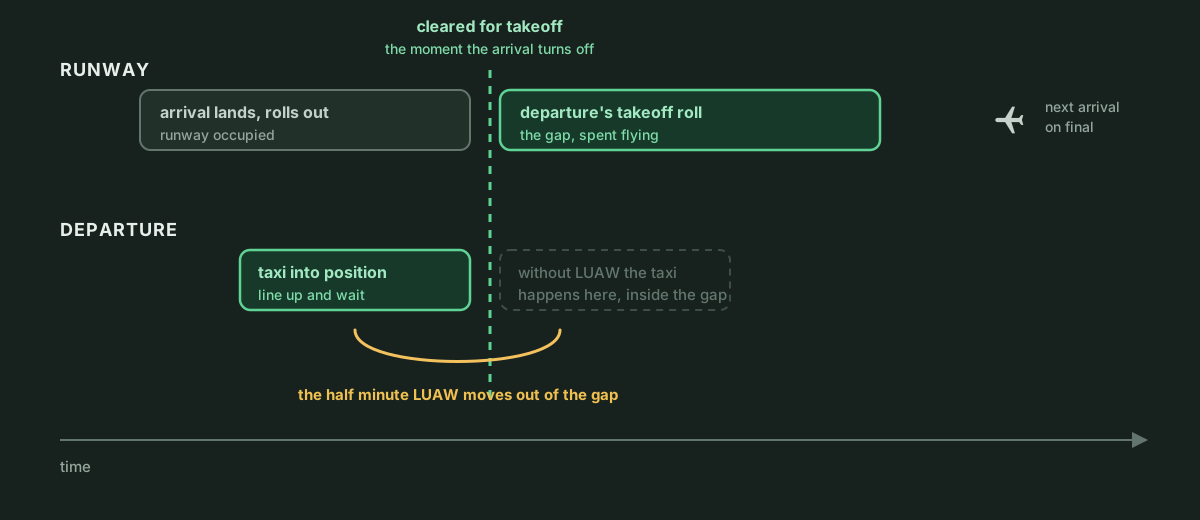
To fit a departure into the gap between two arrivals on the same runway, watch the first arrival touch down and pass the holding point. Authorise line up and wait while the arrival is rolling out only at a facility whose safety logic runs in full core alert mode with weather at or above 800 feet and 2 miles; otherwise wait until the arrival has exited. Once the arrival clears the exit hold bars and your scan confirms the next arrival on final leaves enough room, issue the takeoff clearance. When the gap on final is tight, use "cleared immediate takeoff" so the crew rolls without delay.
Southwest One Five Two Three, runway two five right, line up and wait, traffic a Boeing seven three seven on a four mile final.
Runway two five right, line up and wait, Southwest One Five Two Three.
Southwest One Five Two Three, runway two five right, wind two five zero at eight, cleared immediate takeoff.
Runway two five right, cleared immediate takeoff, Southwest One Five Two Three.
Cancelling a takeoff and handing off to departure
When circumstances change after a takeoff clearance is issued, such as a vehicle entering the runway or an arrival stopping in the exit throat, you must cancel the clearance.
Cancel a previously issued clearance for takeoff and inform the pilot of the reason if circumstances require. Once an aircraft has started takeoff roll, cancel the takeoff clearance only for the purpose of safety.
If the aircraft is still at the holding point or stationary on the centreline, cancel the takeoff clearance, instruct the pilot to hold position, and state the reason. Once the takeoff roll has started, a high-speed abort risks blown tyres, overheated brakes, or a runway overrun. Never cancel a rolling aircraft to meet a traffic flow or route spacing requirement; stop a roll only for safety. Once the aircraft rotates and lifts off, a takeoff clearance can no longer be cancelled, and you manage any conflict in the air.
American Two One Five, runway two five right, wind two five zero at eight, cleared for takeoff.
Runway two five right, cleared for takeoff, American Two One Five.
American Two One Five, hold position, cancel takeoff, vehicle on the runway.
Holding position, American Two One Five.
United Four Four Seven, contact Bayview Departure, one two four point six.
One two four point six, United Four Four Seven.
After liftoff, once the aircraft is climbing cleanly and clear of local traffic conflicts, hand it off to Bayview Departure on 124.60. That radar controller issues the climb and turns.
In the Sim
In ATC Simulator, a departure that calls ready at the holding point sits in the PENDING bay of the strip board flagged "Called ready for departure, needs a runway", and moves to SEQ when placed in the plan. You may clear a departure for takeoff directly from the holding point without issuing line up and wait first. The lesson "Getting them airborne" demonstrates this at Runway 25R with United Four Four Seven sent through line up and wait and JetBlue Eight One cleared directly from the holding point once the runway and final are clear. The lesson "Both streams" puts two departures and two arrivals on one runway and introduces line up and wait in the tight gap behind a landing.
Line up and wait is spoken runway first ("United Four Four Seven, runway two five right, line up and wait"); conditional clearances cannot be spoken. A crew left in position without a takeoff clearance calls after 90 seconds ("holding in position runway two five right") and again every 30 seconds. In the takeoff clearance, the wind is optional and accepted anywhere in the transmission, but placing it between the runway and the clearance ("runway two five right, wind two five zero at eight, cleared for takeoff") earns the +5 standard-phraseology bonus. "Cleared immediate takeoff" is also understood for tight gaps.
Pilots refuse clearances they cannot safely use and state why: "traffic on the runway", "traffic crossing the runway", "traffic on the taxiway", "vehicle on the runway", "traffic still on the runway", or "wake turbulence, we will wait for the heavy". A light aircraft is not lined up behind a departing heavy or super, avoiding sitting out the wake interval on the runway. How often a pilot spots traffic on the runway depends on difficulty: 80 percent at Beginner, 55 percent at Advanced, and 30 percent at Expert.
The next aircraft may be released onto the runway behind a departure once that leader is airborne and 6,000 feet down the runway (3,000 feet if both are light aircraft). Anticipated separation from the holding point assumes the roll starts about 14 seconds after the clearance, or 8 seconds for an immediate takeoff. Wake intervals are 120 seconds after a heavy departure for any following class except a super, 180 seconds after a super departure for any following class except another super, and 120 seconds after a medium departure for a light aircraft.
Line up and wait is accepted behind a landing roll, a vacating aircraft, or a takeoff roll on the same runway. Two strips in the RWY bay normally mean a Runway incursionAnything on protected runway surface that should not be there: an aircraft past its hold line, a vehicle without approval. The accident category towers exist to prevent.Open in the glossary (-100 points), except for an aircraft lined up behind exiting traffic. With a takeoff clearance behind a departing leader that is not yet clear, the pilot lines up anyway, reports "holding in position runway two five right, traffic on the runway", and waits.
"Hold position, cancel takeoff" is understood as one instruction, and "stop immediately" or "stop stop stop" halts a rolling aircraft. An aircraft at the holding point stays put ("holding position"), one that has not rotated brakes to a stop on the runway, and one already airborne replies "we are airborne". On the score sheet, a departure airborne within 90 seconds of calling ready earns +10 points (slow flow earns nothing), rolling less than two minutes after the previous departure on the same route costs 10 points, and handing a flight to Bayview Departure on 124.60 when its strip flags "Climbing out, hand them to departure" earns +15 points.