Chapter 12
Getting Them Down
How local control receives arrivals on final, issues landing clearances, anticipates runway separation, and turns aircraft off to ground.
Check-in on final and continuing the approach
Getting an arrival down is the other half of the local controller's job in the tower cab. By the time an inbound flight switches to your frequency, approach control has already vectored it onto final, set its spacing behind the aircraft ahead, and cleared it for the instrument approach, as covered in chapter 6. Those two clearances do separate jobs. The approach clearance authorises the pilot to fly the lateral and vertical path of the ILS toward the field, while the runway surface itself belongs to Local controlThe tower position that owns the active runway and the sky immediately around it; Tower on the radio. Every use of the runway happens on its say-so.Open in the glossary. An aircraft cleared for the approach still needs your permission before its wheels touch the pavement.
The handoff from approach normally arrives outside the final approach fix, five to eight miles from the threshold. The pilot checks in with the callsign and the approach being flown. Before you key the microphone, run the visual and strip-board scan from chapter 10: check the runway from threshold to departure end, check the RWY bay, and note any departure in position or arrival rolling out.
If the runway is clear and no departure is going out ahead, you can issue the landing clearance on initial contact. At a busy airport, the pavement is often still occupied when the pilot checks in five or six miles out. When you cannot clear the flight to land yet, tell it to continue and give traffic information.
Bayview Tower, American Two One Five, ILS runway two five right.
American Two One Five, Bayview Tower, runway two five right, continue, traffic departing prior to your arrival.
Continue approach runway two five right, American Two One Five.
Telling an arrival to continue confirms that the pilot is on your frequency and sequenced for the runway, while promising nothing about landing. As the aircraft follows the glideslope at roughly two and a half miles a minute, the time for a clearance shortens. You must clear the runway and issue the landing clearance while the flight still has a comfortable margin on final.
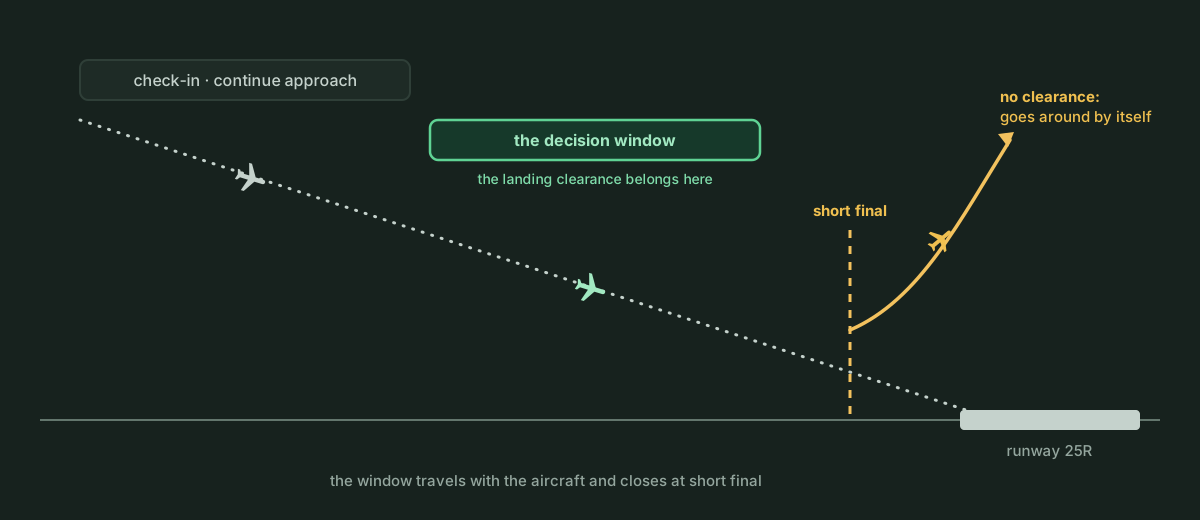
Pilots monitor their distance to the threshold throughout final. If a crew reaches short final without a landing clearance, they do not continue over the approach lights waiting for a call; they add power and fly the missed approach on their own. Even with a landing clearance, a crew that sees an occupied runway on short final goes around.
The landing clearance
Once you can assure a clear runway for the arrival, you issue the landing clearance. Like the takeoff clearance in chapter 11, a landing clearance starts with the runway identifier so the crew verifies the surface before hearing the authorisation.
When issuing a clearance to land, first state the runway number followed by the landing clearance.
PhraseologyRUNWAY (number) CLEARED TO LAND.
noteA clearance to land means that appropriate separation on the landing runway will be ensured. A landing clearance does not relieve the pilot from compliance with any previously issued restriction.
In the FAA manual, the basic civil phraseology states the runway number followed by "Cleared to landRunway two five right, cleared to land.The runway is yours to land on. It may be issued while the aircraft ahead is still clearing, on the judgement that the runway will be free at the threshold.Open in the glossary", while the military tower rule places the surface wind between the runway and the clearance. Civil towers normally put the wind in the ATIS and give it on request; many include it in the clearance anyway. Giving the wind between the runway and the clearance every time is a sound habit because it delivers the runway, the wind, and the clearance in one order.
American Two One Five, runway two five right, wind two five zero at eight, cleared to land.
Cleared to land runway two five right, American Two One Five.
When you say "cleared to land", you guarantee that prescribed runway separation will exist by the time the aircraft crosses the threshold. That clearance leaves in place any speed or altitude restriction already assigned, and the pilot reads back the runway identifier so both of you confirm the same surface. At airports with intersecting runways, civil towers sometimes issue Land and Hold shortStop before the runway's holding position marking and do not enter. Hold short instructions must be read back.Open in the glossary Operations clearances, which clear an aircraft to land and hold short of an intersecting runway or taxiway and require a hold-short ReadbackThe pilot repeating a clearance or instruction back so the controller can verify it was received correctly.Open in the glossary; those operations are not used in ATC Simulator.
Anticipating runway separation
New local controllers sometimes assume they must wait until a landed aircraft has crossed the hold bars before clearing the next arrival on final. Where radar has spaced arrivals three or four miles apart, waiting until the first aircraft is completely off the runway would leave the trailing crew without a clearance until short final. The rules let you look ahead and anticipate separation as the sequence develops.
Landing clearance to succeeding aircraft in a landing sequence need not be withheld if you observe the positions of the aircraft and determine that prescribed runway separation will exist when the aircraft crosses the landing threshold. Issue traffic information to the succeeding aircraft if a preceding arrival has not been previously reported and when traffic will be departing prior to their arrival.
Anticipating separation must not be applied when conducting LUAW operations, except as authorized in subparagraph 3-10-5e2. Issue applicable traffic information when using this provision.
Anticipating separation means judging the movement of both aircraft over the next minute. A jet that has touched down on runway 25R and is decelerating toward a downfield turn-off will VacateLeave the runway. An aircraft is clear of the runway once all of it is past the holding position marking, and the pilot is the one who determines it.Open in the glossary well before a trailing arrival four miles back reaches the threshold. When you observe both positions and determine that prescribed runway separation will exist as the second aircraft crosses the threshold, you may clear the second aircraft to land right away and include traffic information on the aircraft ahead. Where approach control established the final sequence, the landing sequence number is optional.
Bayview Tower, Delta Four Eight Two, ILS runway two five right.
Delta Four Eight Two, Bayview Tower, runway two five right, wind two five zero at eight, cleared to land, traffic is a Boeing Seven Three Seven rolling out ahead.
Cleared to land runway two five right, looking for the traffic, Delta Four Eight Two.
This rule does not apply when an aircraft is lined up and waiting (chapter 11), except at towers where the safety-logic system in its full configuration allows it and weather is at least ceiling 800 feet and visibility two miles. Without full safety logic, you do not clear an arrival to land while another aircraft is holding in position on the same runway or taxiing to LUAW. Until the aircraft in position exits the runway or starts its takeoff roll, withhold the landing clearance, instruct the arrival to continue, and report traffic holding in position. Once the departure starts its roll, clear the arrival to land and advise it of the departing traffic.
Runway changes and wrong-surface alignments
Most arrivals land on the runway they were briefed to expect by approach control, but wind shifts or traffic surges occasionally require a late runway change. A crew established on final has set their avionics and visual scan for the original surface. Stating a new runway number once inside a standard landing clearance risks the pilot hearing the clearance while flying toward the old runway.
To prevent that mistake, FAA phraseology requires you to preface the clearance with "change to runway" and the new number, and then state the runway number a second time before "cleared to land". Repeating the runway identifier after "change to runway" stresses that the landing surface has changed.
Delta Two Zero Two, change to runway three three, runway three three, wind two five zero at eight, cleared to land.
Change to runway three three, cleared to land runway three three, Delta Two Zero Two.
A different problem arises when your scan out the window or on the tower radar display shows an arrival aligned with the wrong surface, such as a parallel runway, an intersecting runway, or a taxiway. Inform the pilot at once. If the aircraft is aligned with a taxiway, is too close to the threshold to correct safely, or tracks toward an occupied runway, send it around and state why ("Delta Two Zero Two, Go aroundGo around, I say again, go around.An instruction or pilot decision to abandon the approach and climb straight ahead or on the missed approach, after which the aircraft is re-sequenced.Open in the glossary, you appear to be aligned with a taxiway"). If time permits further out, ask the pilot to verify alignment with the assigned runway, or clear the flight to land on the parallel runway it is aligned with if that surface is clear.
Vacating the runway and the handoff to ground
A landing aircraft occupies the runway through touchdown and roll-out, and your job shifts to getting it off the pavement and handing it to Ground controlThe tower position that owns the taxiways. It delivers departures to the holding point and takes arrivals back once they are clear of the runway.Open in the glossary.
Instruct aircraft where to turn-off the runway after landing, when appropriate, and advise the aircraft to hold short of a runway or taxiway if required for traffic.
noteRunway exiting or taxi instructions should not normally be issued to an aircraft prior to, or immediately after, touchdown.
Timing matters when you speak to a landing crew. During flare, touchdown, spoiler deployment, and reverse thrust, cockpit workload is high as the pilots keep the aircraft centred and slowing. Wait until the nosewheel is down and the roll-out is under control before issuing turn-off instructions. You can assign an exit with "turn left at taxiway foxtrot" or "turn left next taxiway", or add "if able" when offering an earlier turn-off. Even without an ATC instruction, a pilot is expected to taxi clear of the landing runway at a suitable taxiway, though a pilot may never exit onto an intersecting runway without ATC authorisation.
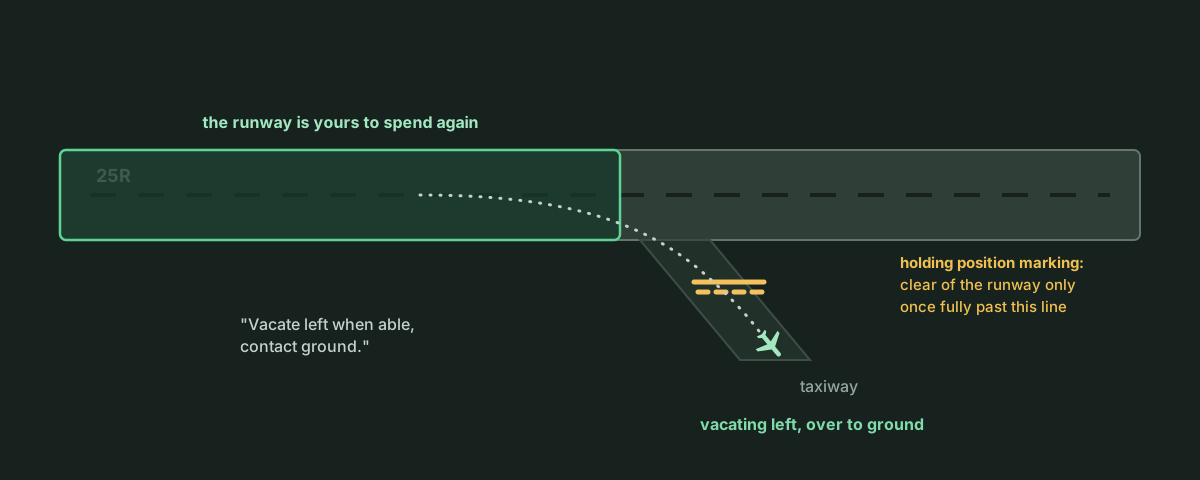
An aircraft is clear of the runway only when the entire airframe has crossed the runway holding position marking painted across the exit taxiway. Because the cockpit crosses that line well ahead of the tail, the pilot is responsible for knowing when the whole aircraft is past the hold bars. Where an exit requires an aircraft to enter an adjacent taxiway, ramp, or intersecting runway to pull its tail past the landing runway's hold marking, both local and ground control must protect that intersection. When traffic requires the exiting aircraft to stop after turning off, add a hold-short instruction ("turn left at taxiway echo, hold short of taxiway alpha") and request a readback if not received.
Once the aircraft is turning onto a clear exit and needs no further instruction from the cab, transfer it to ground control. If the crew must cross an active runway or follow a restriction before changing frequencies, issue those instructions first; on a routine exit, combine the turn-off and the handoff in one call. At many towers you include the ground frequency, and once the tail crosses the hold marking, the runway is free again.
American Two One Five, turn left at taxiway foxtrot, contact ground.
Left at taxiway foxtrot, over to ground, American Two One Five.
In the Sim
In ATC Simulator, arrivals reach the tower frequency established on the ILS and already cleared for the approach by approach control ("Bayview Tower, American Two One Five, ILS runway two five right"). They still need your landing clearance. You can tell an arrival to continue ("American Two One Five, continue"); the pilot acknowledges, the landing clearance state is "continue", and the strip shows the distance with CONT. A strip is flagged when an arrival is inside four miles without a landing clearance, or inside two miles after being told to continue ("On final without a landing clearance"). On the frequency, an arrival inside three miles with no landing clearance asks once ("Bayview Tower, American Two One Five, three mile final runway two five right, request landing clearance"), and inside one and a half miles with no clearance the pilot goes around without being told. A pilot who can see traffic on the runway inside about six tenths of a mile goes around even with a clearance, and the chance that the pilot sees it depends on the difficulty level.
The landing clearance in the lesson is "runway two five right, wind two five zero at eight, cleared to land". The wind is optional and accepted anywhere, while the order runway, wind, clearance keeps the +5 standard-phraseology bonus. An arrival established on one runway that is cleared to land on another answers with the runway it is on ("we are on final runway two five right"). The lesson "In the cab" has one arrival, Delta Two Zero Two, seven miles out, and teaches looking at the runway before the clearance. The guided lesson "Getting them down" puts American Two One Five at five miles and Delta Four Eight Two at eleven miles on the ILS runway 25R: you tell the first to continue, clear it inside four miles, and clear the second to land while the first is still rolling out, anticipating separation, which the sim judges at the threshold.
The runway counts as occupied while an aircraft is landing, vacating, or stopped on it, and is free again when the whole aircraft is clear of the runway pavement. An arrival inside two miles with an occupied runway ahead raises a predicted alert first; clearing an arrival onto an occupied runway charges a Runway incursionAnything on protected runway surface that should not be there: an aircraft past its hold line, a vehicle without approval. The accident category towers exist to prevent.Open in the glossary (-100 and a strike) and marks two strips in the RWY bay amber or red. At Bayview runway 25R, the exit nodes are taxiways Delta, Echo, Foxtrot, Golf, and Hotel. You can issue "turn left next taxiway, contact ground", "turn left at taxiway golf, contact ground", or "vacate left when able, contact ground" (accepted, though not graded as standard phraseology). The contact-ground half is optional, and because ground is a computer voice in the sim, no frequency is given. A landing aircraft given nothing chooses an exit itself and rolls out toward it. When an aircraft is clear of the runway or stopped on it, its strip is flagged ("give them the turn-off and send them to ground") and an aircraft waiting for the tower calls again after thirty seconds; with ground combined, the same strip asks for the turn-off and then the taxi in. Working a landing to the exit and handing it to ground scores +25, an arrival that reaches or passes the runway without its landing clearance or handoff costs -10, and a go-around caused by your sequence or clearance costs -30, while one nobody could have prevented costs nothing.