Chapter 05
Controlling an Arrival
Take an arrival from its entry fix to the base leg using headings, descents, and speed reductions while managing route restrictions and compression.
From the entry fix to the base leg
When Cascade Center hands an arrival to Bayview Approach on one two four point six, the flight enters your airspace at about 12,000 to 13,000 feet on a published STAR such as the RONBY One or the NOLGO Two. As chapter 4 showed, the arrival procedure steps the aircraft down toward the terminal basin and ends short of the runway. Your job in the middle of the sector is to take the flight from its entry fix and deliver it to the base leg ready to turn onto the final approach course, which chapter 6 covers.
Before an arrival turns toward the localizer for Runway 25R or Runway 33, you want three numbers settled: altitude, speed, and heading. On the base leg, the aircraft should be level at (or descending smoothly into) the glideslope intercept altitude, such as 4,000 feet at the SOLAN fix for Runway 25R, so it captures the glidepath from below. Its airspeed should be reduced to 170 or 180 knots so the turn radius stays tight enough to roll out on the centreline without overshooting. Its heading should place it on a clean downwind or base leg that sets up the intercept turn.
When traffic is light, you can leave the arrival on its charted procedure and let its onboard automation fly the lateral track and crossing restrictions. When streams from different corners of the sector converge on the same runway, you step in with radar vectors, assigned altitudes, and speed adjustments. Most shifts blend both methods: the STAR handles the outer fixes, and you take tactical control as the aircraft enters the downwind or base leg.
Taking an arrival off the procedure
Under FAA Order JO 7110.65 paragraph 5-6-1, a controller in controlled airspace vectors aircraft for separation, safety, noise abatement, operational advantage, a confidence manoeuvre, or on pilot request. At an approach control facility, separation and operational advantage drive almost every turn you issue. You might turn an arrival twenty degrees off course to build spacing behind another stream, widen a downwind leg to delay a sequence, or cut across a dogleg on the chart when the pattern is open.
You issue a vector by stating the direction of turn and the three-digit magnetic heading ("turn left heading two four zero"), instructing the pilot to "fly heading" or "fly present heading", or giving the number of degrees to turn and the direction. When a vector is started, tell the pilot its purpose, such as "vector for spacing", and what to expect afterward, such as "expect direct" a fix.
While a crew is flying a "descend via" clearance on a STAR, the Flight Management System (FMS) follows the charted waypoints and computes a descent path to meet each published crossing altitude and speed. Once you vector the aircraft or approve a deviation off the arrival, all published altitude and speed restrictions on the procedure are cancelled, and the FMS may level the aircraft at whatever altitude the pilot last set.
When vectoring or approving course deviations, assign an altitude to maintain and, if necessary, a speed, when:
The vector or approved deviation is off an assigned procedure that contains published altitude or speed restrictions, i.e., SID, STAR, and a clearance to Climb Via/Descend Via has been issued.
noteAfter a climb via or descend via clearance has been issued, a vector/deviation off of a SID/STAR cancels all published altitude and speed restrictions on the procedure. The aircraft's Flight Management System (FMS) may be unable to process crossing altitude restrictions once the aircraft leaves the SID/STAR lateral path. Without an assigned altitude, the aircraft's FMS may revert to leveling off at the altitude set by the pilot, which may be the SID/STAR published top or bottom altitude.
Because a vector cancels the vertical profile, you must assign an altitude to maintain (and a speed if you need one) whenever you take an arrival off a procedure that carries restrictions. If you intend to put the aircraft back on the procedure later, say so when you start the turn: state the heading, the altitude to maintain, and "expect to resume" the arrival at a named fix.
Bayview Approach, American Two One Five, leaving nine thousand for six thousand.
American Two One Five, Bayview Approach, turn left heading two four zero, vector for spacing, descend and maintain six thousand.
Left heading two four zero, descend and maintain six thousand, American Two One Five.
American Two One Five, fly present heading, descend and maintain five thousand.
Fly present heading, descend and maintain five thousand, American Two One Five.
Clearing an arrival direct to a downstream fix also takes it off the intervening route segments and cancels its published vertical clearance. An aircraft told to resume a procedure with crossing restrictions must be reissued those restrictions or told to descend via again; clearing it direct to a fix and then to descend via the arrival restores both. Whenever you vector a flight, provide radar guidance until it is back on a route it can navigate by itself, then issue "resume own navigation" or clear it direct to a fix.
American Two One Five, proceed direct MIKSA, then descend via the RONBY One arrival.
Direct MIKSA, then descend via the RONBY One arrival, American Two One Five.
Managing the descent
Once an aircraft is off its published vertical profile, it holds its last assigned altitude until you clear it lower with "descend and maintain" and the new altitude. The pilot starts the descent on receipt of the clearance and descends at the usual rate (the Aeronautical Information Manual suggests 500 to 1,500 feet per minute) until reaching the assigned level. An altitude once left may not be returned to without a new clearance.
A clearance that names a crossing altitude at a fix, such as "cross ULPEX at six thousand", allows descent at the pilot's discretion for that portion of the flight. The crew may stay level until their computed top-of-descent point and then descend to meet the restriction at the fix. At any other time, you must say "descend at pilot's discretion" if you want to allow a discretionary descent.
A specified altitude over a specified fix for that portion of a descent clearance where descent at pilot's discretion is permissible. At any other time it is practicable, authorize climb/descent at pilot's discretion.
PhraseologyCLIMB/DESCEND AT PILOT'S DISCRETION.
Example"United Four Seventeen, descend and maintain six thousand."
noteThe pilot is expected to commence descent upon receipt of the clearance and to descend at the suggested rates specified in the AIM, paragraph 4-4-10, Adherence to Clearance, until reaching the assigned altitude of 6,000 feet.
A descent clearance that replaces pilot's discretion is an amended altitude, prefaced with the words "amend altitude". When a flight is still on a STAR and you only need to change a single restriction, use "descend via the RONBY One arrival, except cross ULPEX at seven thousand", and the pilot will fly the remaining restrictions as published.
United Four Four Seven, cross ULPEX at six thousand.
Cross ULPEX at six thousand, United Four Four Seven.
United Four Four Seven, amend altitude, descend and maintain five thousand.
Descend and maintain five thousand, United Four Four Seven.
You also have to issue the clearance far enough ahead of the target point that the aircraft can physically lose the altitude. Controllers plan descents around a simple rule of thumb: an airliner needs about three nautical miles of ground track for every thousand feet to lose.
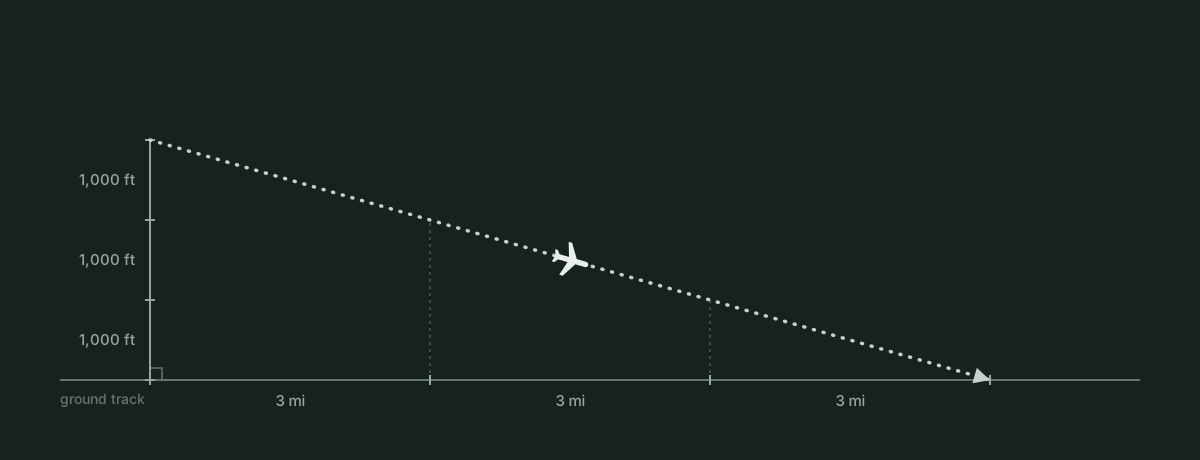
Check a descent by comparing the aircraft's miles to go against its thousands of feet to lose multiplied by three. Losing 6,000 feet from 10,000 down to 4,000 feet takes about 18 miles of track at a constant speed. Slowing down on the way needs extra distance on top, because a clean jet must flatten its descent for several miles to bleed off airspeed.
Every assigned altitude is bounded by terrain below and aircraft performance above. Under paragraph 5-6-1, aircraft are vectored at or above the Minimum Vectoring Altitude (MVA) or the Minimum IFR Altitude, except where the procedure for a radar approach, radar departure, or special VFR allows otherwise. At Bayview, Kestrel Ridge has a 4,000-foot MVA floor, Northshore Hills has a 3,000-foot floor, and the central basin has a 2,000-foot floor. If you assign an altitude below the local MVA or above the aircraft's ceiling, the crew will say "UnableUnable.A pilot says this when an instruction is unsafe or beyond the aircraft's capability, requiring a new clearance from you.Open in the glossary" and give the reason, and you must issue revised instructions. 14 CFR 91.123 is why the crew cannot simply deviate without an amended clearance.
Slowing an arrival and fighting compression
Slowing an arrival adjusts spacing when aircraft are already established on the route you want them to fly. Speeds are given as knots of indicated airspeed in multiples of five, such as 210 or 180 knots, and a pilot who flies an assigned speed holds it within about 10 knots. Decide the interval you want and the point where you want it before transmitting. Speed changes are not instantaneous: they take longer and more distance at higher altitude, at higher speed, and in a clean configuration. Keep adjustments to the minimum needed to build or hold the interval, avoid alternating decreases and increases, and end the adjustment with "resume normal speed" when it is no longer needed.
Keep speed adjustments to the minimum necessary to achieve or maintain required or desired spacing. Avoid adjustments requiring alternate decreases and increases. Terminate speed adjustments when no longer needed.
noteIt is the pilot's responsibility and prerogative to refuse speed adjustment that he/she considers excessive or contrary to the aircraft's operating specifications.
Approach clearances or climb via/descend via clearances cancel any previously assigned speeds. Pilots are expected to make their own speed adjustments to fly the approach, SID, or STAR unless assigned speeds are restated.
Below 10,000 feet MSL, 250 knots is the regulatory ceiling under 14 CFR 91.117. On the low side, paragraph 5-7-3 sets the speed floors a controller works to: turbojet arrivals below 10,000 feet get not less than 210 knots, or 170 knots within 20 flying miles of the runway threshold; propeller and turboprop arrivals get 200 knots, or 150 knots inside 20 miles (departures get 230 knots for turbojets and 150 knots for propeller aircraft). Lower speeds may be assigned when operationally advantageous, and it remains the pilot's prerogative to refuse a speed he considers excessive or contrary to the aircraft's operating limits by saying "unable".
Delta Eight Eight, reduce speed to two one zero knots.
Reduce speed to two one zero knots, Delta Eight Eight.
Southwest Eight Eight, reduce speed to one eight zero knots.
Unable one eight zero knots, minimum clean speed is one nine zero knots, Southwest Eight Eight.
Southwest Eight Eight, maintain one nine zero knots.
Maintain one nine zero knots, Southwest Eight Eight.
The main hazard in a line of arrivals is compression, where the aircraft behind catches the one ahead after the leader enters the terminal area and slows down. Once the lead flight slows to 210 knots on downwind and 180 knots on base while the trailing flight is still at 250 knots, the gap shrinks by about two-thirds of a mile every minute on downwind and more than a mile every minute on base.
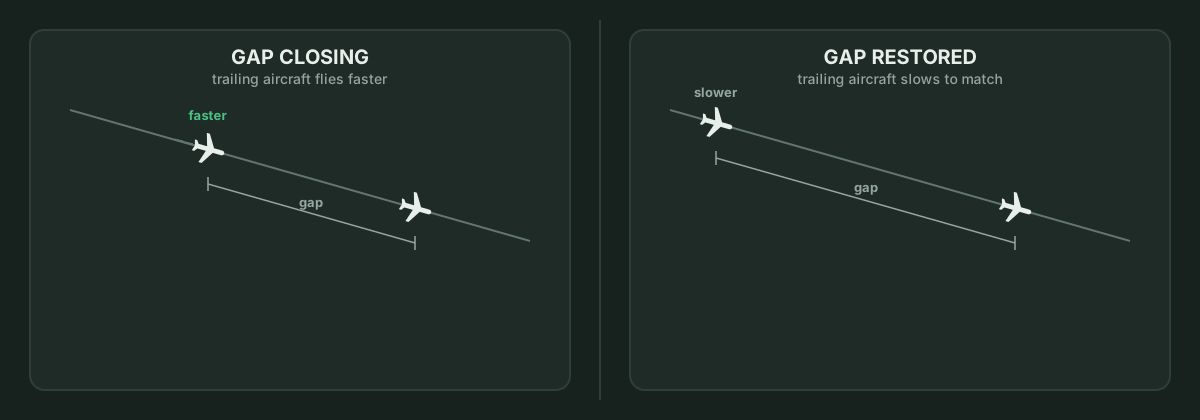
Under paragraph 5-7-1, compression is handled by slowing the trailing aircraft first, speeding the leading aircraft first, or assigning a specific speed to both flights. When slowing a whole stream of arrivals, work from the back of the line to the front so trailing flights never overrun the leaders.
Keep track of what cancels a speed restriction. A speed restriction published on a STAR is cancelled when the aircraft is vectored off or sent direct to a fix. An approach clearance cancels speeds assigned earlier so the pilot can fly the approach speed schedule; restate any speed that you still want the crew to hold on the initial approach segment. Do not assign speeds to an aircraft inside the final approach fix on final or within 5 miles of the runway, whichever is closer to the runway.
Speed and heading trade off against each other. Speed control costs no track miles and keeps the flight on its own navigation, whereas a vector builds delay at the price of distance flown and requires you to keep track of where the aircraft is going afterward.
Checking the setup before the turn to final
Before turning an arrival toward the localizer in chapter 6, check three items on the scope:
- Altitude: At or descending into the glideslope intercept altitude (4,000 feet at the SOLAN fix for Runway 25R) and at or above the local MVA.
- Speed: Reduced to a base-leg speed (170 or 180 knots for a jet within 20 miles of the threshold) so the turn onto final stays tight.
- Heading: Positioned on a downwind or base leg with room outside the final approach fix to level off before capturing the glideslope.
American Two One Five, descend and maintain four thousand, reduce speed to one eight zero knots.
Descend and maintain four thousand, reduce speed to one eight zero knots, American Two One Five.
American Two One Five, resume normal speed.
Resume normal speed, American Two One Five.
In the Sim
In ATC Simulator, four commands do the whole job on an arrival, whether spoken in standard phraseology or entered on the aircraft sheet: "turn left heading two four zero" (or "fly present heading"), "descend and maintain four thousand feet", "reduce speed to one eight zero knots" (also "increase speed to" and "resume normal speed"), and "proceed direct RONBY". Real-world forms such as "cross ULPEX at six thousand", "amend altitude", and "descend via" are not accepted by the simulator. On touch devices, the aircraft sheet has HDG and ALT steppers that move by 5 degrees and 1,000 feet per tap and transmit once you stop tapping, a SPD stepper in 10-knot steps, and a DIRECT button.
Bayview's four arrivals (RONBY One, NOLGO Two, TISBA Three, and HALME One) carry published at-or-below altitudes stepping from 10,000 feet (11,000 on HALME One) down to 7,000 feet and a 230-knot limit at the last fix. Each arrival is created with its own level in the stack of the fix it is bound for and keeps it, so untouched arrivals do not run into one another by design. Your own altitude outranks the procedure's: an arrival told to descend to 4,000 feet is not lifted back to a published at-or-above, and one told to climb is not brought down by a later at-or-below. An assigned speed likewise outranks a published one, while "resume normal speed" hands speed control back to the procedure and never exceeds 250 knots.
A heading cancels the aircraft's route and any hold, and the flight continues on that heading until told otherwise. A heading also takes an aircraft off an approach it is already established on, though an approach clearance it has not yet used survives the vector. Proceeding direct to a fix replaces the route with that single fix and also drops an approach the aircraft is established on.
Simulated pilots enforce terrain floors and aircraft performance limits. Bayview has a 4,000-foot MVA floor over Kestrel Ridge, a 3,000-foot floor over Northshore Hills, and a 2,000-foot floor elsewhere. A pilot refuses a descent below the MVA where the aircraft currently sits and states why in words ("terrain, the minimum vectoring altitude over Kestrel Ridge is four thousand"). An altitude above what the aircraft can fly is also refused ("... is above our ceiling, we can make ..."), while a speed outside the aircraft's envelope is clamped and the pilot reports the speed being maintained.
The sim cautions without refusing when you assign a speed below the paragraph 5-7-3 floor for that aircraft, or when you assign a speed inside five miles of the runway on final ("no speed assignment inside five mile final", where the approach speed governs). Inside eight miles of the runway on final, the crew slows toward its approach speed; an assigned speed is flown down to five miles and only the approach speed outranks it inside that point. Issuing an approach clearance cancels any previously assigned speed so the arrival returns to its own schedule.
Track miles are scored against the direct line: flying more than the allowance beyond the direct path costs 1 point a mile, capped at 15 points per flight, while keeping a flight inside the allowance earns 5 points. In the approach course, lessons 3 ("Altitude and speed"), 4 ("Fixes and direct routing"), and 5 ("The arrival") let you practice these controls before the ILS lessons.