Chapter 01
ATC Basics
Learn what air traffic control is for, how a flight passes from controller to controller, how radio calls work, and how a shift runs in Bayview Approach.
What ATC is and what comes first
What is ATC? Air traffic control (ATC) is a ground-based service in which controllers monitor aircraft on radar and from the control tower, issue radio instructions, and keep flights safely apart from pushback to touchdown. At a busy airport, dozens of jets arrive and depart at the same time along paths that cross in clouds and darkness, where flight crews cannot rely on seeing each other out of the windscreen to stay clear.
In the United States, the procedures for every facility are set out in FAA Order JO 7110.65, which opens by defining the system's purpose and services.
The primary purpose of the ATC system is to prevent a collision involving aircraft operating in the system.
The ATC system must provide certain additional services to the extent permitted. The provision of additional services is not optional on the part of the controller, but rather required when the work situation permits.
Alongside preventing collisions, ATC provides a safe, orderly, and fast flow of traffic so departures climb out without delay and arrivals reach the runway in an organised stream. Controllers must also provide additional services, such as weather updates and traffic advisories, whenever the work situation allows. HeavyUnited Four Heavy, Bayview Approach.A wake-turbulence class carried in the callsign of aircraft able to take off at 300,000 pounds or more, because the wake they leave behind is a hazard to whoever follows.Open in the glossary traffic volume, frequency congestion, radar limitations, controller workload, and higher-priority duties can all preclude those extra services at a busy moment.
When several aircraft need attention on the frequency at once, the manual defines what comes first by setting a strict order of priority.
Give first priority to separating aircraft and issuing safety alerts as required in this order. Good judgment must be used in prioritizing all other provisions of this order based on the requirements of the situation at hand.
Separation is the hard rule: keep aircraft a defined minimum distance apart, vertically in feet or laterally in miles, at all times. If two targets are losing separation while another flight calls for a routine descent, you resolve the conflict and issue any needed safety alert before answering the routine call. Beyond separation and safety alerts, you weigh the situation on your scope and perform the most safety-critical action first, a priority rule that governs every competing task in later chapters.
Responsibility for safety is shared between the control room and the cockpit. Controllers follow the procedures and separation minima in the order unless a stated exception applies, such as a facility letter of agreement or an emergency. Pilots remain responsible for obeying the aviation regulations they fly under regardless of an ATC instruction, and they will speak up if a clearance would put the aircraft in an unsafe condition.
Who controls a flight from gate to gate
A flight passes along a chain of controllers from departure to destination. The sky is divided into three-dimensional volumes of airspace called sectors, each defined by a lateral outline on a chart and a vertical ceiling and floor. A controller owns the traffic inside one sector, and each facility is named on the radio by place and function, such as Bayview Tower, Bayview Approach, or Cascade Center.
For a typical airline flight, what each controller does depends on the stage of the flight: the chain begins on the airport surface with Clearance Delivery, which issues the route and altitude assignment, and Ground controlThe tower position that owns the taxiways. It delivers departures to the holding point and takes arrivals back once they are clear of the runway.Open in the glossary, which directs aircraft on the taxiways. At the runway edge, Ground transfers the flight to the Tower, which controls the runway and its immediate surroundings. After takeoff, the Tower switches the aircraft to Departure Control, a terminal radar facility that works the climb through the middle ring of airspace around the airport and is usually part of the same facility as Approach Control.
Climbing into the high airspace between airports, the jet is handed off from Departure to an en route Center. Near the destination, the sequence runs in reverse: Center hands the descending flight to Approach Control for the middle ring around the airport, Approach lines it up for the runway and hands it to the Tower for landing, and the Tower switches it to Ground Control once it has vacated the runway.
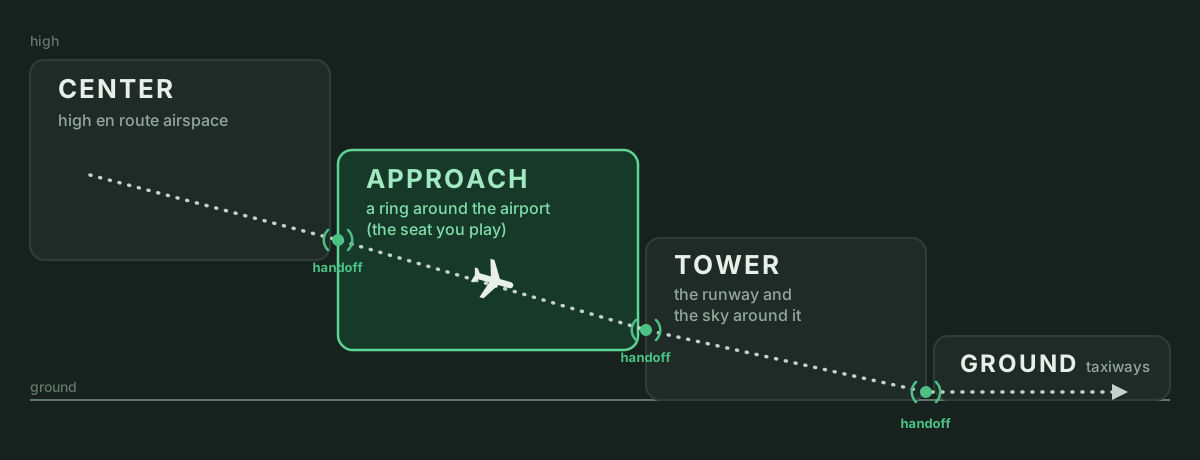
At every boundary, a clear handoff ensures authority never overlaps or drops out. Control transfers at a coordinated location, time, fix, or altitude, or once a radar handoff and frequency change to the receiving controller are complete and authorised by a letter of agreement or facility directive.
Transfer control of an aircraft only after eliminating any potential conflict with other aircraft for which you have separation responsibility. Assume control of an aircraft only after it is in your area of jurisdiction unless specifically coordinated or as specified by letter of agreement or a facility directive.
You eliminate any potential conflict with your other traffic before switching an aircraft to the next frequency, and when receiving a flight, you wait until it enters your jurisdiction before turning or descending it unless a facility directive or prior coordination authorises early control.
Inside the approach sector
This book begins in the terminal radar room at Bayview International Airport, where you work as Bayview Approach. You own a middle ring of airspace around the airport up to fifteen thousand feet. Cascade Center owns the high airspace above you, feeding arrivals such as the RONBY one arrival and taking your climbing departures, while Bayview Tower owns the runways and the final approach path to the threshold.
When an arrival enters from Cascade Center, the pilot switches to your frequency, one two four point six, and checks in. After finding the target on your scope, you reply "Radar contactAmerican Two One Five, radar contact.I have identified you on my display and will provide radar flight following. Said when identification is established, and the pilot can stop making position reports.Open in the glossary," telling the pilot the target is identified and tracked so you can separate and sequence the flight by radar.
Between check-in and the runway, what the controller does in the approach seat is separation and sequencing. You use vectors, altitudes, and speeds to keep aircraft apart by distance in miles and altitude in feet, and to blend arrivals from different directions into a single line with safe spacing for the runway.
To reach the runway safely, what the pilot needs from you is a conflict-free path, an approach clearance, and a timely frequency change. Once an arrival is at the proper altitude, free of conflicts, and aligned to intercept the final approach course, you clear it for the approach. Once established on the approach, you hand it off by instructing the pilot to contact Bayview Tower on one one eight point three. For a departure climbing off the runway, you keep it clear of the arrival stream and hand it off to Cascade Center on one three three point six five.
How to talk on the radio
Every trainee asks how to talk on the radio. An ATC frequency is a single shared party line where only one transmitter can speak at a time, so calls follow a short, fixed pattern.
When you transmit, you key the microphone, say the aircraft's callsign, add your facility name on your first call to that flight, and state your instruction. When you release the key, the pilot repeats the instruction and ends with the callsign. That ReadbackThe pilot repeating a clearance or instruction back so the controller can verify it was received correctly.Open in the glossary lets you verify that the right pilot heard the instruction and will do what you asked.
The two exchanges below follow American Two One Five from initial check-in with Bayview Approach on the RONBY one arrival through approach clearance and handoff to Bayview Tower for Runway 25R.
Bayview Approach, American Two One Five, RONBY one arrival, descending four thousand.
American Two One Five, Bayview Approach, radar contact, descend and maintain three thousand.
Descend and maintain three thousand, American Two One Five.
On first contact, the pilot states your facility first, then the callsign, the RONBY one arrival, and the altitude the flight is descending toward. You answer with the callsign first, identify Bayview Approach, state radar contact, and assign a lower altitude. Once the flight is lined up for final approach, you clear it for the approach and switch it to the tower.
American Two One Five, cleared ILS approach runway two five right.
Cleared ILS approach runway two five right, American Two One Five.
American Two One Five, contact Bayview Tower, one one eight point three.
Contact Bayview Tower, one one eight point three, American Two One Five.
If a pilot asks "how do you read" for a radio check, you answer with the callsign and "reading you five," meaning loud and clear. Chapter 2 covers headings, speeds, altitudes, and reading the scope, and chapter 3 covers radio phraseology in detail.
In the Sim
ATC Simulator gives you two seats at Bayview International: Approach in the radar room and Tower in the cab. What you will do in the game is work live traffic by voice from those seats, starting in the Approach seat where your scope shows an eight-sided sector outline with a fifteen-thousand-foot ceiling. Bayview Approach is on one two four point six, Bayview Tower is on one one eight point three, Cascade Center above Bayview is on one three three point six five, and Bayview's ATIS is on one two eight point six.
Arrivals check in by voice, for example "Bayview Approach, American two one five, RONBY one arrival, descending four thousand," while departures off the runway call "Bayview Departure" with the altitude they are climbing toward. To talk, hold the transmit pad, or latch it open in settings, and say the callsign followed by the instruction. In lessons and at the Beginner tier, a call with no callsign goes to the selected aircraft or the lone aircraft on frequency; Advanced and Expert require the callsign on every call. Plain English works, while standard phraseology, including "radar contact" with or without a position, earns an extra five points per transmission. The question mark button beside the transmit pad opens a card of standard phrases for your seat.
Voice handoffs are scored. Handing an established arrival to the tower with "contact Bayview Tower, one one eight point three" scores twenty-five points, while an arrival that reaches or passes the runway without a landing clearance or handoff is a late handoff and costs ten points. Handing a departure to Center with "contact Cascade Center, one three three point six five" scores fifteen points, and the aircraft stays on the scope, dimmed, with a "to Center" mark on its callsign.
Separation is scored continuously. Two aircraft closer than three miles and one thousand feet cost one hundred points, with the horizontal minimum reduced to two point five miles on the same final inside ten miles and increased behind a heavy aircraft. A Runway incursionAnything on protected runway surface that should not be there: an aircraft past its hold line, a vehicle without approval. The accident category towers exist to prevent.Open in the glossary also costs one hundred points. Violations and incursions count as strikes; three strikes end the shift, and a collision ends it at once. Unlike a real radar room, the sim does not reproduce landline or interphone coordination with Center and the tower, so you work only the Bayview Approach frequency and the voice call is the handoff.
From here, you can start the unlocked twenty-three-lesson training ladder in its suggested order: Lesson 1, "Reading the scope," involves no radio calls, and Lesson 2, "Your first vector," is your first transmission. You can also practise with Radio School's Pilot and Controller shelves, or turn to chapter 2 to learn the language of the sky.